
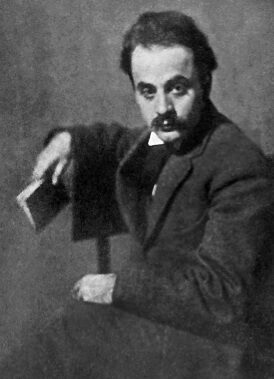
Kahlil Gibran
Kahlil Gibran was a Lebanese-American writer, poet, and painter. Born January 6, 1883, in Bsharri. Died April 10, 1931, in New York City. Known for The Prophet, Broken Wings and Sand and Foam. Educated at Académie Julian.
Facts
29 facts · 2 confirmed by two sources · 9 cited · 16 from one source · 2 where the sources disagree
What’s different
- Cause of death: we show liver cirrhosis (Sources disagree). Wikidata also lists tuberculosis and cancer
- Name at birth: we show جُبْران خَليل ميخائيل سَعْد جُبْران (Sources disagree). Wikidata also lists Gibran Khalil Gibran
Where this comes from
Papalocal keeps its own record. It started from these sources; what each one said is kept here as it was copied, so a change on their side never changes this page by itself. Tap one to read its version.
What Wikidata says · copied November 16, 2026 · revision 2558083001
- Described as
- Lebanese-American writer, poet, and painter (1883–1931)
- Other names
- Jubrān Khalīl Jubrān, Gibran Khalil Gibran, Jubran, Jubran Khalil, Khalil Gibran, K. Gibran, Jubrān, Jubrān Khalīl
- Born
- January 6, 1883 · 14 references
- Died
- April 10, 1931 · 14 references
- Born in
- Bsharri
- Died in
- New York City · 1 reference
- Buried in
- Bsharri · 1 reference
- Cause of death
- liver cirrhosis; tuberculosis; cancer
- Name at birth
- جُبْران خَليل ميخائيل سَعْد جُبْران; Gibran Khalil Gibran
- Citizen of
- Ottoman Empire; State of Greater Lebanon; Lebanese Republic under French mandate
- Occupation
- writer · 5 references; poet · 3 references; painter · 2 references; philosopher · 1 reference; short story writer; visual artist · 1 reference
- Education
- Académie Julian
- Genre
- poetry · 1 reference; parable; fable
- Known for
- The Prophet; Broken Wings; Sand and Foam; The Processions
- Field
- creative and professional writing · 1 reference; poetry · 1 reference
- Religion
- Maronites
- Lived in
- Tenth Street Studio Building (1911–1931) · 1 reference
- Website
- https://www.kahlilgibran.com/ · 1 reference
- Wikipedias with a page
- 158
Wikidata item Q47737 (wikidata.org/wiki/Q47737), public domain (CC0). Copied November 16, 2026.
What Wikipedia says · copied November 16, 2026 · revision 1385784239
Jubrān Khalīl Jubrān (Arabic: جُبْرَان خَلِيل جُبْرَان; January 6, 1883 – April 10, 1931), usually referred to in English as Kahlil Gibran, was a Lebanese-American writer, poet and visual artist. He was also considered a philosopher, although he himself rejected the title. He is best known as the author of The Prophet, which was first published in the United States in 1923 and has since become one of the best-selling books of all time, having been translated into more than 100 languages.
Born in Bsharri, a village of the Ottoman-ruled Mount Lebanon Mutasarrifate to a Maronite Christian family, young Gibran immigrated with his mother and siblings to the United States in 1895. As his mother worked as a seamstress, he was enrolled at a school in Boston, where his creative abilities were quickly noticed by a teacher who presented him to photographer and publisher F. Holland Day. Gibran was sent back to his native land by his family at the age of fifteen to enroll at the Collège de la Sagesse in Beirut. Returning to Boston upon his youngest sister's death in 1902, he lost his older half-brother and his mother the following year, seemingly relying afterwards on his remaining sister's income from her work at a dressmaker's shop for some time.
In 1904, Gibran's drawings were displayed for the first time at Day's studio in Boston, and his first book in Arabic was published in 1905 in New York City. With the financial help of a newly met benefactress, Mary Haskell, Gibran studied art in Paris from 1908 to 1910. While there, he came in contact with Syrian political thinkers promoting rebellion in Ottoman Syria after the Young Turk Revolution; some of Gibran's writings, voicing the same ideas as well as anti-clericalism, would eventually be banned by the Ottoman authorities. In 1911, Gibran settled in New York, where his first book in English, The Madman, was published by Alfred A. Knopf in 1918, with writing of The Prophet or The Earth Gods also underway. His visual artwork was shown at Montross Gallery in 1914, and at the galleries of M. Knoedler & Co. in 1917. He had also been corresponding remarkably with May Ziadeh since 1912. In 1920, Gibran re-founded the Pen League with fellow Mahjari poets. By the time of his death at the age of 48 from cirrhosis and incipient tuberculosis in one lung, he had achieved literary fame on "both sides of the Atlantic Ocean", and The Prophet had already been translated into German and French. His body was transferred to his birth village of Bsharri (in present-day Lebanon), to which he had bequeathed all future royalties on his books, and where a museum dedicated to his works now stands.
In the words of Suheil Bushrui and Joe Jenkins, Gibran's life was "often caught between Nietzschean rebellion, Blakean pantheism and Sufi mysticism". Gibran discussed different themes in his writings and explored diverse literary forms. Salma Khadra Jayyusi has called him "the single most important influence on Arabic poetry and literature during the first half of [the twentieth] century", and he is still celebrated as a literary hero in Lebanon. At the same time, "most of Gibran's paintings expressed his personal vision, incorporating spiritual and mythological symbolism", with art critic Alice Raphael recognizing in the painter a classicist, whose work owed "more to the findings of Da Vinci than it [did] to any modern insurgent". His "prodigious body of work" has been described as "an artistic legacy to people of all nations".
- Born, in its opening lines
- January 6, 1883
- Died, in its opening lines
- April 10, 1931
From the Wikipedia article “Kahlil Gibran” (en.wikipedia.org/wiki/Kahlil_Gibran), by its contributors, under CC BY-SA 4.0 (creativecommons.org/licenses/by-sa/4.0/). Copied November 16, 2026; not changed.
Confirmed Two sources agree. Cited One source, and it names where it got it. One source One source, without a reference of its own. Sources disagree The sources disagree. We show the best-supported value and keep theirs below.
