
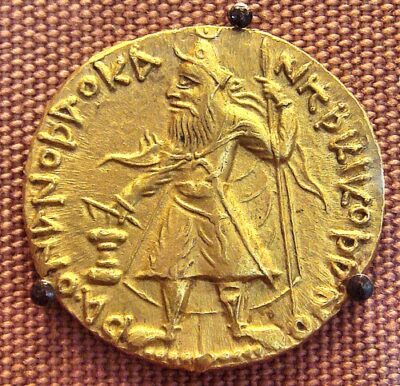
Kanishka
Kanishka was the fourth and greatest Kushan emperor. Born 78, in Peshawar. Died 144, in Peshawar. Positions held include emperor (127–150).
Facts
13 facts · 0 confirmed by two sources · 0 cited · 11 from one source · 2 where the sources disagree
What’s different
- Born: we show 78 (Sources disagree). Wikipedia says 127
- Died: we show 144 (Sources disagree). Wikipedia says 150
Where this comes from
Papalocal keeps its own record. It started from these sources; what each one said is kept here as it was copied, so a change on their side never changes this page by itself. Tap one to read its version.
What Wikidata says · copied November 16, 2026 · revision 2553916650
- Described as
- the fourth and greatest Kushan emperor (127–150)
- Born
- 78
- Died
- 144
- Born in
- Peshawar · 1 reference
- Died in
- Peshawar · 1 reference
- Buried in
- Peshawar · 1 reference
- Citizen of
- Kushan Empire
- Occupation
- monarch
- Positions held
- emperor (127–150)
- Spouse
- Supriya; Vidyamati
- Children
- Huvishka
- Father
- Vima Kadphises
- Religion
- Buddhism
- Wikipedias with a page
- 52
Wikidata item Q312544 (wikidata.org/wiki/Q312544), public domain (CC0). Copied November 16, 2026.
What Wikipedia says · copied November 16, 2026 · revision 1379165482
Kanishka I, also known as Kanishka the Great, was an emperor of the Kushan dynasty, under whose reign (c. 127–150 CE) the empire reached its zenith. He is famous for his military, political, and spiritual achievements. A descendant of Kujula Kadphises, founder of the Kushan Empire, Kanishka came to rule an empire extending from Central Asia and Gandhara to Pataliputra in the Gangetic plains. The main capital of his empire was located at Puruṣapura (Peshawar) in Gandhara, with another major capital at Mathura. Coins of Kanishka were found at Tripuri (present-day Jabalpur).
Although he never converted to the religion, his conquests and patronage of Buddhism played an important role in the development of the Silk Road, and in the transmission of Mahayana Buddhism from Gandhara across the Karakoram range to China. Around 127 CE, he replaced Greek with Bactrian as the official language of administration in the empire.
Earlier scholars believed that Kanishka ascended the Kushan throne in 78 CE, and that this date was used as the beginning of the Saka calendar era. However, historians no longer regard this date as that of Kanishka's accession. Falk estimates that Kanishka came to the throne in 127 CE.
- Born, in its opening lines
- 127
- Died, in its opening lines
- 150
From the Wikipedia article “Kanishka” (en.wikipedia.org/wiki/Kanishka), by its contributors, under CC BY-SA 4.0 (creativecommons.org/licenses/by-sa/4.0/). Copied November 16, 2026; not changed.
Confirmed Two sources agree. Cited One source, and it names where it got it. One source One source, without a reference of its own. Sources disagree The sources disagree. We show the best-supported value and keep theirs below.
