
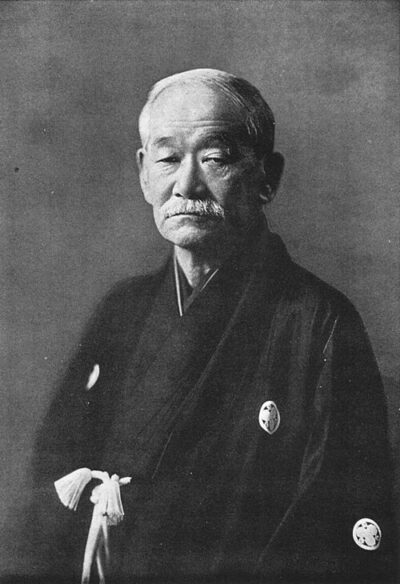
Kanō Jigorō
Kanō Jigorō was a Japanese educator and judoka. Born December 10, 1860, in Kobe. Died May 4, 1938, in at sea. Positions held include member of the House of Peers (1922–). Educated at Nishogakusha University and Tokyo University. Awards include Order of the Rising Sun, 3rd class, Order of the Rising Sun, 1st class and Asahi Prize.
Facts
37 facts · 2 confirmed by two sources · 7 cited · 28 from one source
Where this comes from
Papalocal keeps its own record. It started from these sources; what each one said is kept here as it was copied, so a change on their side never changes this page by itself. Tap one to read its version.
What Wikidata says · copied November 16, 2026 · revision 2569409662
- Described as
- Japanese educator and judoka (1860–1938)
- Other names
- Kano Jigoro, Jigorō Kanō, Jigoro Kano, KANŌ Jigorō
- Born
- December 10, 1860 · 3 references
- Died
- May 4, 1938 · 2 references
- Born in
- Kobe · 1 reference
- Died in
- at sea · 2 references
- Buried in
- Yahashira Cemetery
- Cause of death
- pneumonia
- Citizen of
- Japan
- Occupation
- judoka; educator; translator · 1 reference; politician; martial artist · 1 reference; pedagogue · 1 reference; functionary · 1 reference
- Positions held
- member of the House of Peers (1922–)
- Worked for
- Fifth High School; Tokyo Higher Normal School; Gakushūin; Toyo University; First Higher School; Kobun Institute; Kōdōkan
- Education
- Nishogakusha University; Tokyo University
- Member of
- International Olympic Committee; Japan Sport Association
- Sport
- judo · 1 reference
- Awards
- Order of the Rising Sun, 3rd class (1938) · 1 reference; Order of the Rising Sun, 1st class; Asahi Prize (1935); Order of the Sacred Treasure, 1st Class (1920); Order of the Sacred Treasure, 2nd Class (1911); Order of the Sacred Treasure, 3rd class (1906); Order of the Sacred Treasure, 4th class (1902); Order of the Sacred Treasure, 5th Class (1898); Order of the Sacred Treasure, 6th class (1896)
- Children
- Risei Kanō
- Wikipedias with a page
- 59
Wikidata item Q190141 (wikidata.org/wiki/Q190141), public domain (CC0). Copied November 16, 2026.
What Wikipedia says · copied November 16, 2026 · revision 1385936649
Kanō Jigorō (嘉納 治五郎; 10 December 1860 – 4 May 1938) was a Japanese judoka, educator, politician, and the founder of judo. Judo was one of the first Japanese martial arts to gain widespread international recognition, and the first to become an official Olympic sport since 1964 (for men) and 1992 (for women), as well as the Commonwealth Games sport in 1990. Pedagogical innovations attributed to Kanō include the use of black and white belts, and the introduction of dan ranking to show the relative ranking among members of a martial-art-style. Well-known mottoes attributed to Kanō include "maximum efficiency minimal effort" (精力善用, seiryoku zen'yō) and "mutual welfare and benefit" (自他共栄, jita kyōei).
In his professional life, Kanō was an educator and a promoter of multiple sports in Japan, including swimming, athletics, weightlifting and other forms of physical education. Aside from judo, he is considered by some to be the originator of modern strength training in Japan. He also helped Gichin Funakoshi and other masters to introduce and systematize karate in the country. He was also a high member of the Dai Nippon Butoku Kai martial arts organization, and played a key role in making judo and kendo part of the Japanese public school programs. His cousin Kenji Kanō, founder of one of the first western boxing clubs in Japan, was also influenced by him.
Important postings included serving as director of primary education for the Ministry of Education (文部省, Monbushō) from 1898 to 1901, and as president of Tokyo Higher Normal School from 1900 until 1920. He was the educational founder of Nada Middle High School in Kobe, Japan. Accomplishments included being the first Asian member of the International Olympic Committee (IOC) (serving from 1909 to 1938), officially representing Japan at most Olympic Games held between 1912 and 1936, and serving as a leading spokesman for Japan's bid for the 1940 Olympic Games.
His official honors and decorations included the First Order of Merit and Grand Order of the Rising Sun and the Third Imperial Degree. Kanō was inducted as the first member of the International Judo Federation (IJF) Hall of Fame on 14 May 1999.
- Born, in its opening lines
- December 10, 1860
- Died, in its opening lines
- May 4, 1938
From the Wikipedia article “Kanō Jigorō” (en.wikipedia.org/wiki/Kanō_Jigorō), by its contributors, under CC BY-SA 4.0 (creativecommons.org/licenses/by-sa/4.0/). Copied November 16, 2026; not changed.
Confirmed Two sources agree. Cited One source, and it names where it got it. One source One source, without a reference of its own. Sources disagree The sources disagree. We show the best-supported value and keep theirs below.
