
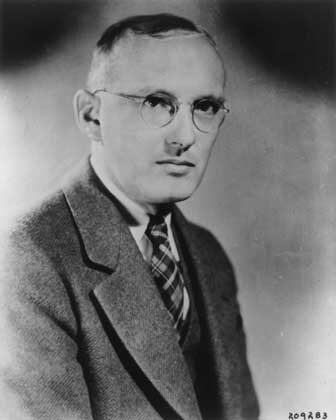
Karl Guthe Jansky
Karl Guthe Jansky was an American physicist and radio engineer. Born October 22, 1905, in Norman. Died February 14, 1950, in Red Bank. Educated at University of Wisconsin–Madison.
Facts
19 facts · 2 confirmed by two sources · 11 cited · 6 from one source
Where this comes from
Papalocal keeps its own record. It started from these sources; what each one said is kept here as it was copied, so a change on their side never changes this page by itself. Tap one to read its version.
What Wikidata says · copied November 13, 2026 · revision 2567620727
- Described as
- American physicist and radio engineer
- Other names
- Karl Jansky
- Born
- October 22, 1905 · 6 references
- Died
- February 14, 1950 · 5 references
- Born in
- Norman · 1 reference
- Died in
- Red Bank · 1 reference
- Buried in
- Forest Hill Cemetery · 1 reference
- Cause of death
- heart failure
- Citizen of
- United States
- Occupation
- astronomer; physicist · 1 reference; inventor · 1 reference; astrophysicist · 1 reference
- Worked for
- Bell Labs
- Education
- University of Wisconsin–Madison
- Field
- physics; radio astronomy · 2 references; radio wave · 1 reference; atmospheric wave · 1 reference; radio-frequency engineering · 1 reference; radiotelephony · 1 reference
- Wikipedias with a page
- 44
Wikidata item Q319212 (wikidata.org/wiki/Q319212), public domain (CC0). Copied November 13, 2026.
What Wikipedia says · copied November 13, 2026 · revision 1384368819
Karl Guthe Jansky (October 22, 1905 – February 14, 1950) was an American physicist and radio engineer who in April 1933 first announced his discovery of radio waves emanating from the Milky Way in the constellation Sagittarius. An amateur astronomer, he is considered one of the founding figures of radio astronomy.
- Born, in its opening lines
- October 22, 1905
- Died, in its opening lines
- February 14, 1950
From the Wikipedia article “Karl Guthe Jansky” (en.wikipedia.org/wiki/Karl_Guthe_Jansky), by its contributors, under CC BY-SA 4.0 (creativecommons.org/licenses/by-sa/4.0/). Copied November 13, 2026; not changed.
Confirmed Two sources agree. Cited One source, and it names where it got it. One source One source, without a reference of its own. Sources disagree The sources disagree. We show the best-supported value and keep theirs below.
