
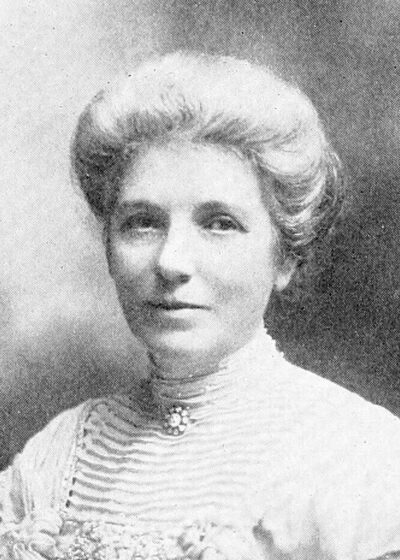
Kate Sheppard
Kate Sheppard was a prominent member of New Zealand's women's suffrage. Born March 10, 1847, in Liverpool. Died July 13, 1934, in Riccarton.
Facts
19 facts · 1 confirmed by two sources · 7 cited · 10 from one source · 1 where the sources disagree
What’s different
- Born: we show March 10, 1847 (Sources disagree). Wikipedia says March 10, 1848
Where this comes from
Papalocal keeps its own record. It started from these sources; what each one said is kept here as it was copied, so a change on their side never changes this page by itself. Tap one to read its version.
What Wikidata says · copied November 16, 2026 · revision 2562429047
- Described as
- prominent member of New Zealand's women's suffrage (1848–1934)
- Other names
- Katherine Wilson Sheppard, Catherine Wilson Sheppard, Katherine Wilson "Kate" Sheppard, Catherine Wilson Malcolm, Katherine Wilson Lovell-Smith
- Born
- March 10, 1847 · 2 references
- Died
- July 13, 1934 · 2 references
- Born in
- Liverpool · 1 reference
- Died in
- Riccarton · 1 reference
- Buried in
- Addington Cemetery · 1 reference
- Name at birth
- Catherine Wilson Malcolm
- Citizen of
- United Kingdom of Great Britain and Ireland; New Zealand
- Occupation
- women's rights activist; political activist; economist · 1 reference; publisher; journalist; suffragist · 1 reference; feminist · 1 reference; politician
- Member of
- National Council of Women of New Zealand (–1903)
- Spouse
- William Lovell-Smith (1925–) · 1 reference
- Siblings
- Isabella May
- Wikipedias with a page
- 45
Wikidata item Q455072 (wikidata.org/wiki/Q455072), public domain (CC0). Copied November 16, 2026.
What Wikipedia says · copied November 16, 2026 · revision 1385796240
Katherine Wilson Sheppard (born Catherine Wilson Malcolm; 10 March 1848 – 13 July 1934) was a New Zealand suffragist known for organising the 1893 Women's Suffrage Petition that resulted in New Zealand becoming the first country to establish universal suffrage.
Born in Liverpool, England, she emigrated to New Zealand with her family in 1868. There she became an active member of various religious and social organisations, including the Women's Christian Temperance Union New Zealand (WCTU NZ). In 1887 she was appointed the WCTU NZ's National Superintendent for Franchise and Legislation, a position she used to advance the cause of women's suffrage in New Zealand.
Sheppard promoted women's suffrage by organising petitions and public meetings, by writing letters to the press, and by developing contacts with politicians. She was the editor of The White Ribbon, the first woman-operated newspaper in New Zealand. Through her skilful writing and persuasive public speaking, she successfully advocated women's suffrage. Her pamphlets Ten Reasons Why the Women of New Zealand Should Vote and Should Women Vote? contributed to the cause. This work culminated in a petition with 30,000 signatures calling for women's suffrage that was presented to parliament, and the successful extension of the franchise to women in 1893. As a result, New Zealand became the first country to establish universal suffrage.
Sheppard was the first president of the National Council of Women of New Zealand, founded in 1896, and helped reform the organisation in 1918. In later life, she travelled to Britain and assisted the suffrage movement there. With failing health, she returned to New Zealand, after which she continued to be involved in writing on women's rights, although she became less politically active. She died in 1934, leaving no descendants.
Sheppard is considered an important figure in New Zealand's history. A memorial to her exists in Christchurch. Her portrait replaced that of Queen Elizabeth II on the front of the New Zealand ten-dollar note in 1991.
- Born, in its opening lines
- March 10, 1848
- Died, in its opening lines
- July 13, 1934
From the Wikipedia article “Kate Sheppard” (en.wikipedia.org/wiki/Kate_Sheppard), by its contributors, under CC BY-SA 4.0 (creativecommons.org/licenses/by-sa/4.0/). Copied November 16, 2026; not changed.
Confirmed Two sources agree. Cited One source, and it names where it got it. One source One source, without a reference of its own. Sources disagree The sources disagree. We show the best-supported value and keep theirs below.
