
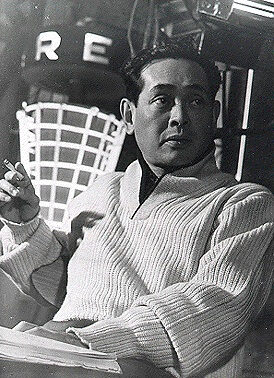
Keisuke Kinoshita
Keisuke Kinoshita was a Japanese film director. Born December 5, 1912, in Hamamatsu. Died December 30, 1998, in Tokyo. Known for Carmen Comes Home, Twenty-Four Eyes and The Ballad of Narayama. Awards include Order of the Rising Sun, 4th class, Medal with Purple Ribbon and Person of Cultural Merit.
Facts
20 facts · 2 confirmed by two sources · 4 cited · 14 from one source
Where this comes from
Papalocal keeps its own record. It started from these sources; what each one said is kept here as it was copied, so a change on their side never changes this page by itself. Tap one to read its version.
What Wikidata says · copied November 18, 2026 · revision 2558081691
- Described as
- Japanese film director (1912-1998)
- Born
- December 5, 1912 · 4 references
- Died
- December 30, 1998 · 4 references
- Born in
- Hamamatsu · 1 reference
- Died in
- Tokyo · 1 reference
- Citizen of
- Empire of Japan (–1947); Japan
- Occupation
- film director; screenwriter · 1 reference; film producer; director · 1 reference
- Known for
- Carmen Comes Home; Twenty-Four Eyes; The Ballad of Narayama
- Awards
- Order of the Rising Sun, 4th class; Medal with Purple Ribbon (1977); Person of Cultural Merit (1991); Mainichi Film Award for Best Screenplay (3 times) (1952, 1954, 1955); Mainichi Film Award for Best Director
- Siblings
- Chūji Kinoshita; Yoshiko Kusuda
- Wikipedias with a page
- 20
Wikidata item Q1388372 (wikidata.org/wiki/Q1388372), public domain (CC0). Copied November 18, 2026.
What Wikipedia says · copied November 18, 2026 · revision 1373750057
Keisuke Kinoshita (木下 惠介, Kinoshita Keisuke; December 5, 1912 – December 30, 1998) was a Japanese film director and screenwriter. While lesser-known internationally than contemporaries such as Akira Kurosawa, Kenji Mizoguchi and Yasujirō Ozu, he was a household figure in his home country, beloved by both critics and audiences from the 1940s to the 1960s. Kinoshita's films were marked by a sense of sentimentality, purity, and beauty, and often featured experimentation in both technique and subject matter.
Kinoshita entered the film industry in 1933 as a film processor. He moved on to the position of camera assistant, then assistant director. In 1943, Kinoshita was promoted to director and released his first film, Port of Flowers. A prolific filmmaker, Kinoshita directed 43 films in the first 23 years of his career, and then five more after a stint in television production. Among his best known films are Carmen Comes Home (1951), A Japanese Tragedy (1953), Twenty-Four Eyes (1954), She Was Like a Wild Chrysanthemum (1955) and The Ballad of Narayama (1958).
- Born, in its opening lines
- December 5, 1912
- Died, in its opening lines
- December 30, 1998
From the Wikipedia article “Keisuke Kinoshita” (en.wikipedia.org/wiki/Keisuke_Kinoshita), by its contributors, under CC BY-SA 4.0 (creativecommons.org/licenses/by-sa/4.0/). Copied November 18, 2026; not changed.
Confirmed Two sources agree. Cited One source, and it names where it got it. One source One source, without a reference of its own. Sources disagree The sources disagree. We show the best-supported value and keep theirs below.
