
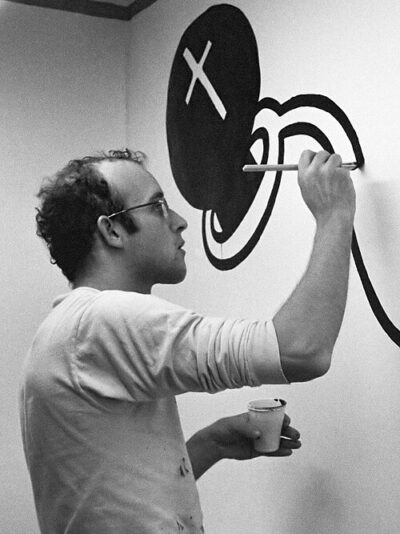
Keith Haring
Keith Haring was an American artist and social activist. Born May 4, 1958, in Reading. Died February 16, 1990, in Manhattan. Known for Tuttomondo, Crack Is Wack and Together we can stop AIDS. Educated at School of Visual Arts and Kutztown Area High School.
Facts
26 facts · 2 confirmed by two sources · 14 cited · 10 from one source
Where this comes from
Papalocal keeps its own record. It started from these sources; what each one said is kept here as it was copied, so a change on their side never changes this page by itself. Tap one to read its version.
What Wikidata says · copied November 13, 2026 · revision 2568107351
- Described as
- American artist and social activist (1958-1990)
- Other names
- Keith Allen Haring
- Born
- May 4, 1958 · 18 references
- Died
- February 16, 1990 · 16 references
- Born in
- Reading · 3 references
- Died in
- Manhattan · 3 references
- Cause of death
- death from AIDS-related complications · 1 reference
- Citizen of
- United States · 1 reference
- Occupation
- painter · 6 references; writer; draftsperson · 4 references; social activist; jewelry designer · 1 reference; photographer · 2 references; graphic artist · 1 reference; sculptor · 2 references
- Education
- School of Visual Arts (1978–); Kutztown Area High School · 1 reference; Art Institute of Pittsburgh (1976–)
- Genre
- figurative art · 1 reference; social-artistic project · 1 reference
- Known for
- Tuttomondo; Crack Is Wack; Together we can stop AIDS
- Field
- graffiti · 1 reference
- Lived in
- Pittsburgh (–1978) · 1 reference; New York City (1978–1990) · 1 reference
- Website
- http://www.haring.com
- Wikipedias with a page
- 59
Wikidata item Q485635 (wikidata.org/wiki/Q485635), public domain (CC0). Copied November 13, 2026.
What Wikipedia says · copied November 13, 2026 · revision 1384784517
Keith Allen Haring (May 4, 1958 – February 16, 1990) was an American artist and activist. Emerging from New York City's downtown art and graffiti scenes in the early 1980s, he transformed subway chalk drawings into an internationally celebrated career that bridged street art and Pop art.
Haring first gained public attention through spontaneous white-chalk drawings on unused black advertising panels in New York City subway stations, featuring crawling babies, barking dogs, dancing figures, and other animated symbols. As his reputation grew, he gained gallery representation and produced large-scale paintings and sculptures. Between 1982 and 1989, he created more than 50 public murals, many of them voluntarily for hospitals, schools, and community spaces.
Much of Haring's work addressed political and social issues, including anti-apartheid activism, the crack epidemic, homosexuality, safe sex, and AIDS awareness, often using his own iconography to communicate urgent messages. In 1986, he opened the Pop Shop to make his art widely accessible through affordable merchandise. In addition to solo exhibitions, he participated in major international shows including documenta in Kassel, the Whitney Biennial in New York, the São Paulo Biennial, and the Venice Biennale. After Haring died of AIDS-related complications in 1990, the Whitney Museum of American Art organized a retrospective of his work in 1997.
Haring’s legacy has also been recognized within LGBTQ history. In 2014, he was among the inaugural honorees of the Rainbow Honor Walk in San Francisco, a walk of fame recognizing LGBTQ people who made significant contributions in their fields. In 2019, he was one of the inaugural 50 American "pioneers, trailblazers, and heroes" inducted onto the National LGBTQ Wall of Honor at the Stonewall Inn in New York City.
- Born, in its opening lines
- May 4, 1958
- Died, in its opening lines
- February 16, 1990
From the Wikipedia article “Keith Haring” (en.wikipedia.org/wiki/Keith_Haring), by its contributors, under CC BY-SA 4.0 (creativecommons.org/licenses/by-sa/4.0/). Copied November 13, 2026; not changed.
Confirmed Two sources agree. Cited One source, and it names where it got it. One source One source, without a reference of its own. Sources disagree The sources disagree. We show the best-supported value and keep theirs below.
