
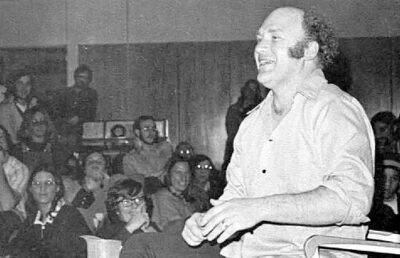
Ken Kesey
Ken Kesey was an American novelist. Born September 17, 1935, in La Junta. Died November 10, 2001, in Sacred Heart Medical Center University District. Known for One Flew Over the Cuckoo's Nest and Sometimes a Great Notion. Educated at University of Oregon and Stanford University.
Facts
25 facts · 2 confirmed by two sources · 7 cited · 16 from one source
Where this comes from
Papalocal keeps its own record. It started from these sources; what each one said is kept here as it was copied, so a change on their side never changes this page by itself. Tap one to read its version.
What Wikidata says · copied November 13, 2026 · revision 2558081766
- Described as
- American novelist (1935–2001)
- Other names
- Ken E. Kesey, Kenneth Kesey, O. U. Levon, Kenneth Elton Kesey, Ken Elton Kesey
- Born
- September 17, 1935 · 13 references
- Died
- November 10, 2001 · 13 references
- Born in
- La Junta · 1 reference
- Died in
- Sacred Heart Medical Center University District
- Buried in
- Kesey Family Farm Cemetery · 1 reference
- Cause of death
- liver cancer
- Citizen of
- United States
- Occupation
- writer · 1 reference; novelist; essayist; children's writer · 1 reference; amateur wrestler · 1 reference
- Education
- University of Oregon; Stanford University · 1 reference; Springfield High School
- Sport
- amateur wrestling
- Known for
- One Flew Over the Cuckoo's Nest; Sometimes a Great Notion
- Field
- literature · 1 reference; postmodern literature · 1 reference
- Children
- Sunshine Kesey
- Father
- Fred Alvin Kesey · 1 reference
- Mother
- Geneva Wilma Smith · 1 reference
- Lived in
- Springfield (1946–) · 1 reference
- Website
- http://www.intrepidtrips.com/
- Wikipedias with a page
- 70
Wikidata item Q244390 (wikidata.org/wiki/Q244390), public domain (CC0). Copied November 13, 2026.
What Wikipedia says · copied November 13, 2026 · revision 1385285795
Kenneth Elton Kesey (; September 17, 1935 – November 10, 2001) was an American novelist, essayist, and countercultural figure. He considered himself a link between the Beat Generation of the 1950s and the hippies of the 1960s.
Kesey was born in La Junta, Colorado, and grew up in Springfield, Oregon, graduating from the University of Oregon in 1957. He began writing One Flew Over the Cuckoo's Nest in 1960 after completing a graduate fellowship in creative writing at Stanford University; the novel was an immediate commercial and critical success when published two years later. During this period, Kesey was used by the CIA (supposedly without his knowledge) in the Project MKULTRA involving hallucinogenic drugs (including mescaline and LSD), which was done to try to make people insane to put them under the control of interrogators.
After One Flew Over the Cuckoo's Nest was published, Kesey moved to nearby La Honda, California, and began hosting "happenings" with former colleagues from Stanford, bohemian and literary figures including Neal Cassady and other friends, who became collectively known as the Merry Pranksters. As documented in Tom Wolfe's 1968 New Journalism book The Electric Kool-Aid Acid Test, some of the parties were promoted to the public as Acid Tests, and integrated the consumption of LSD with multimedia performances. He mentored the Grateful Dead, who were the Acid Tests' house band, and continued to exert a profound influence upon the group throughout their career.
Kesey's second novel, Sometimes a Great Notion, was a commercial success that polarized some critics and readers upon its release in 1964. An epic account of the vicissitudes of an Oregon logging family that aspired to the modernist grandeur of William Faulkner's Yoknapatawpha saga, Kesey regarded it as his magnum opus.
In 1965, after being arrested for marijuana possession and faking suicide, Kesey was imprisoned for five months. Shortly thereafter, he returned home to the Willamette Valley and settled in Pleasant Hill, Oregon, where he maintained a secluded, family-oriented lifestyle for the rest of his life. In addition to teaching at the University of Oregon—an experience that culminated in Caverns (1989), a collaborative novel by Kesey and his graduate workshop students under the pseudonym "O.U. Levon"—he continued to regularly contribute fiction and reportage to such publications as Esquire, Rolling Stone, Oui, Running, and The Whole Earth Catalog; various iterations of these pieces were collected in Kesey's Garage Sale (1973) and Demon Box (1986).
Between 1974 and 1980, Kesey published six issues of Spit in the Ocean, a literary magazine that featured excerpts from an unfinished novel (Seven Prayers by Grandma Whittier, an account of Kesey's grandmother's struggle with Alzheimer's disease) and contributions from writers including Margo St. James, Kate Millett, Stewart Brand, Saul-Paul Sirag, Jack Sarfatti, Paul Krassner and William S. Burroughs. After a third novel (Sailor Song) was released to lukewarm reviews in 1992, he reunited with the Merry Pranksters and began publishing works on the Internet until ill health (including a stroke) curtailed his activities.
- Born, in its opening lines
- September 17, 1935
- Died, in its opening lines
- November 10, 2001
From the Wikipedia article “Ken Kesey” (en.wikipedia.org/wiki/Ken_Kesey), by its contributors, under CC BY-SA 4.0 (creativecommons.org/licenses/by-sa/4.0/). Copied November 13, 2026; not changed.
Confirmed Two sources agree. Cited One source, and it names where it got it. One source One source, without a reference of its own. Sources disagree The sources disagree. We show the best-supported value and keep theirs below.
