
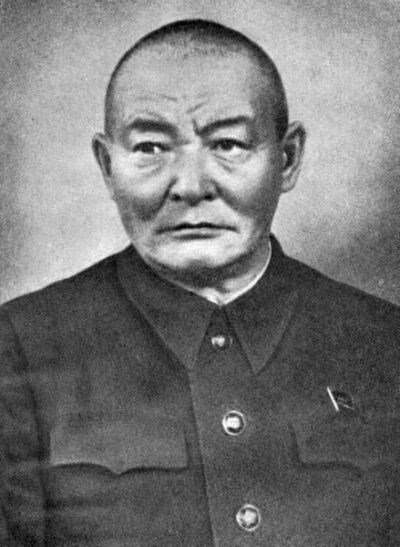
Khorloogiin Choibalsan
Khorloogiin Choibalsan was a Mongolian general and political leader from the 1930s to 1952. Born February 8, 1895, in Dornod Province. Died January 26, 1952, in Moscow. Positions held include Prime Minister of Mongolia (1939–1952) and Minister of Foreign Affairs (1939–1950). Awards include Medal "For the Victory over Japan", Medal "For the Victory over Germany in the Great Patriotic War 1941–1945" and Order of the Red Banner.
Facts
32 facts · 2 confirmed by two sources · 2 cited · 27 from one source · 1 where the sources disagree
What’s different
- Born in: we show Dornod Province (Sources disagree). Wikidata also lists Choibalsan
Where this comes from
Papalocal keeps its own record. It started from these sources; what each one said is kept here as it was copied, so a change on their side never changes this page by itself. Tap one to read its version.
What Wikidata says · copied November 16, 2026 · revision 2567014284
- Described as
- Mongolian general and political leader from the 1930s to 1952
- Other names
- Jorlogin Choibalsán o Coibalsan
- Born
- February 8, 1895 · 2 references
- Died
- January 26, 1952 · 1 reference
- Born in
- Dornod Province; Choibalsan
- Died in
- Moscow · 1 reference
- Buried in
- Sükhbaatar's Mausoleum
- Cause of death
- cancer
- Citizen of
- Mongolia
- Occupation
- politician · 1 reference; military personnel
- Positions held
- Prime Minister of Mongolia (1939–1952); Minister of Foreign Affairs (1939–1950)
- Political party
- Mongolian People's Party
- Awards
- Medal "For the Victory over Japan"; Medal "For the Victory over Germany in the Great Patriotic War 1941–1945"; Order of the Red Banner; Order of Lenin; Jubilee Medal "XX Years of the Workers' and Peasants' Red Army"; Order of Suvorov, 1st class; Hero of the Mongolian People's Republic; Order of Sukhbaatar; Order of the Red Banner; Order of the Red Banner of Labour; Order of the Polar Star; Jubilee Medal "30 Years of the Soviet Army and Navy"; Honorary Officer of the State Security; Medal "For the Victory over Japan" of Mongolia · 1 reference; Badge “Participant in the battles of Khalkhin Gol” · 1 reference
- Children
- Ch. Nergui
- Mother
- Khorloo
- Religion
- atheism
- Military branch
- Mongolian People's Army · 1 reference
- Military rank
- Marshal of the Mongolian People's Republic
- Wikipedias with a page
- 44
Wikidata item Q311488 (wikidata.org/wiki/Q311488), public domain (CC0). Copied November 16, 2026.
What Wikipedia says · copied November 16, 2026 · revision 1384532234
Khorloogiin Choibalsan (8 February 1895 – 26 January 1952) was a Mongolian revolutionary and politician who served as the leader of the Mongolian People's Republic as the chairman of the Council of Ministers (premier) from 1939 until his death in 1952. He was also the commander-in-chief of the Mongolian People's Army from 1937, and the chairman of the Presidium of the State Little Khural (head of state) from 1929 to 1930. His rule was maintained by a repressive state and cult of personality. Choibalsan led a dictatorship and organized Stalinist purges in Mongolia between 1937 and 1939 as head of the Ministry of Internal Affairs.
Choibalsan was one of the 1921 Mongolian revolutionaries and held several political and military roles in the 1920s. Mongolia's economic, political, and military ties to the Soviet Union deepened, though after World War II, Choibalsan supported pan-Mongolian unification with Inner Mongolia. He died of cancer in Moscow in 1952 and was succeeded as leader by his protégé, Yumjaagiin Tsedenbal.
- Born, in its opening lines
- February 8, 1895
- Died, in its opening lines
- January 26, 1952
From the Wikipedia article “Khorloogiin Choibalsan” (en.wikipedia.org/wiki/Khorloogiin_Choibalsan), by its contributors, under CC BY-SA 4.0 (creativecommons.org/licenses/by-sa/4.0/). Copied November 16, 2026; not changed.
Confirmed Two sources agree. Cited One source, and it names where it got it. One source One source, without a reference of its own. Sources disagree The sources disagree. We show the best-supported value and keep theirs below.
