
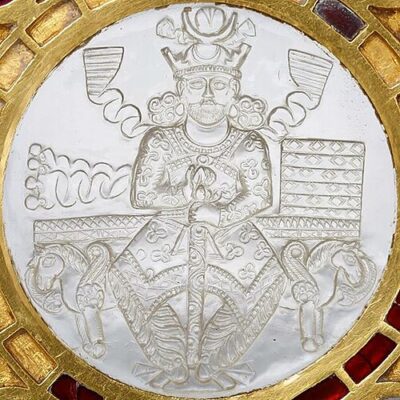
Khosrow I
Khosrow I was a Shahanshah of the Sasanian Empire from 531 to 579. Born 501, in Ardestan. Died 579, in Ctesiphon. Positions held include emperor of the Sasanian Empire (531–579) and commander-in-chief.
Facts
15 facts · 0 confirmed by two sources · 0 cited · 13 from one source · 2 where the sources disagree
What’s different
- Born: we show 501 (Sources disagree). Wikipedia says 488
- Died: we show 579 (Sources disagree). Wikipedia says 496
Where this comes from
Papalocal keeps its own record. It started from these sources; what each one said is kept here as it was copied, so a change on their side never changes this page by itself. Tap one to read its version.
What Wikidata says · copied November 16, 2026 · revision 2558083087
- Described as
- Shahanshah of the Sasanian Empire from 531 to 579
- Other names
- Anushirvan, Khosrow Anushirvan, Khusraw I, Chosroes I, Chosroës I
- Born
- 501
- Died
- 579 · 1 reference
- Born in
- Ardestan
- Died in
- Ctesiphon
- Citizen of
- Sasanian Empire
- Occupation
- sovereign; military leader
- Positions held
- emperor of the Sasanian Empire (531–579); commander-in-chief
- Children
- Hormizd IV; Anosazad · 1 reference
- Father
- Kavad I
- Mother
- Newandukht
- Religion
- Zoroastrianism
- Military branch
- Sasanian military
- Wikipedias with a page
- 65
Wikidata item Q207381 (wikidata.org/wiki/Q207381), public domain (CC0). Copied November 16, 2026.
What Wikipedia says · copied November 16, 2026 · revision 1385461047
Khosrow I (also spelled Khosrau, Khusro or Chosroes; Middle Persian: 𐭧𐭥𐭮𐭫𐭥𐭣𐭩), traditionally known by his epithet of Anushirvan (Middle Persian: 𐭠𐭭𐭥𐭱𐭫𐭥𐭡𐭠𐭭, lit. 'the Immortal Soul'), was the Sasanian King of Kings of Iran from 531 to 579. He was the son and successor of Kavad I (r. 488–496, 498/499–531).
Inheriting a reinvigorated empire at war with the Byzantines, Khosrow I signed a peace treaty with them in 532, known as the Perpetual Peace, in which the Byzantine emperor Justinian I paid 11,000 pounds of gold to the Sasanians. Khosrow then focused on consolidating his power, executing conspirators, including his uncle Bawi. Dissatisfied with the actions of the Byzantine clients and vassals, the Ghassanids, and encouraged by Ostrogoth envoys from Italy, Khosrow violated the peace treaty and declared war against the Byzantines in 540. He sacked the major city of Antioch and deported its population to Persia. In 541, he invaded Lazica and made it an Iranian protectorate, thus initiating the Lazic War. In 545, the two empires agreed to halt the wars in Mesopotamia and Syria while continuing to fight in Lazica. A truce was declared in 557, and by 562 the fifty-year peace treaty was signed.
In 572, Justin II, the successor of Justinian, broke the peace treaty and sent a Byzantine force into the Sasanian region of Arzanene. The following year, Khosrow besieged and captured the important Byzantine fortress-city of Dara, which led to Justin II's insanity. The war lasted until 591, outliving Khosrow. Khosrow's wars were not only focused in the west. To the east, in an alliance with the Göktürks, he finally put an end to the Hephthalite Empire, which had inflicted a handful of defeats on the Sasanians in the 5th century, killing Khosrow's grandfather Peroz I. To the south, Iranian forces led by Wahrez defeated the Aksumites and conquered Yemen.
Khosrow I is known for his character, virtue and knowledge. During his ambitious reign, he continued his father's project of making major social, military, and economic reforms, promoting the welfare of the people, increasing state revenues, establishing a professional army, and founding or rebuilding many cities, palaces, and much infrastructure. He was interested in literature and philosophy, and under his reign, art and science flourished in Iran. He was the most distinguished of the Sasanian kings, and his name became a royal title, like that of Caesar in Roman history.
At the time of his death, the Sasanian Empire had reached its greatest extent since Shapur II, stretching from Yemen in the west to Gandhara in the east. He was succeeded by his son Hormizd IV.
- Born, in its opening lines
- 488
- Died, in its opening lines
- 496
From the Wikipedia article “Khosrow I” (en.wikipedia.org/wiki/Khosrow_I), by its contributors, under CC BY-SA 4.0 (creativecommons.org/licenses/by-sa/4.0/). Copied November 16, 2026; not changed.
Confirmed Two sources agree. Cited One source, and it names where it got it. One source One source, without a reference of its own. Sources disagree The sources disagree. We show the best-supported value and keep theirs below.
