
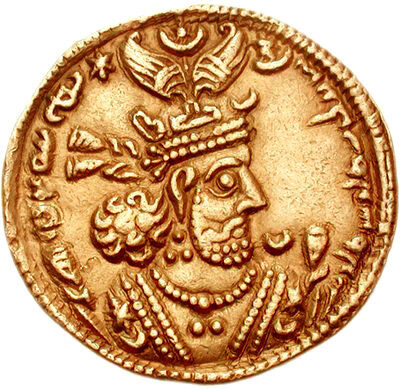
Khosrow II
Khosrow II was The 24th Sassanid emperor. Born 570, in Ctesiphon. Died February 28, 628, in Ctesiphon. Positions held include emperor of the Sasanian Empire (590–).
Facts
24 facts · 0 confirmed by two sources · 1 cited · 21 from one source · 2 where the sources disagree
What’s different
- Born: we show 570 (Sources disagree). Wikipedia says 579
- Died: we show February 28, 628 (Sources disagree). Wikipedia says 590
Where this comes from
Papalocal keeps its own record. It started from these sources; what each one said is kept here as it was copied, so a change on their side never changes this page by itself. Tap one to read its version.
What Wikidata says · copied November 16, 2026 · revision 2558083099
- Described as
- The 24th Sassanid emperor (590–628)
- Other names
- Husraw II, Chosroës II, Chosroes II, Khusrau, Khosrow Parviz
- Born
- 570
- Died
- February 28, 628
- Born in
- Ctesiphon
- Died in
- Ctesiphon
- Cause of death
- decapitation
- Citizen of
- Sasanian Empire
- Occupation
- governor · 1 reference; monarch; military leader
- Positions held
- emperor of the Sasanian Empire (590–)
- Spouse
- Shirin; Maria; Gordiya
- Children
- Kavadh II; Farrukhzad Khosrau V · 1 reference; Azarmidokht; Boran · 1 reference; Mardanshah; Javanshir; Shahriyar
- Father
- Hormizd IV
- Religion
- Zoroastrianism
- Military branch
- Sasanian military
- Lived in
- Taq-i Kisra
- Wikipedias with a page
- 62
Wikidata item Q212732 (wikidata.org/wiki/Q212732), public domain (CC0). Copied November 16, 2026.
What Wikipedia says · copied November 16, 2026 · revision 1384396488
Khosrow II (spelled Chosroes II in classical sources; Middle Persian: 𐭧𐭥𐭮𐭫𐭥𐭣𐭩, romanized: Xusrōγ/Xusrōw and Khosrau), commonly known as Khosrow Parviz (New Persian خسرو پرویز, "Khosrow the Victorious"), is considered to be the last great monarch of pre-Islamic Iran, ruling the Sasanian Empire from 590 to 628, including an interruption of one year.
Khosrow II was the son of Hormizd IV (reigned 579–590), and the grandson of Khosrow I (reigned 531–579). He was the last emperor of Iran to have a lengthy reign before the Muslim conquest of Iran, which began five years after his execution. He lost his throne, then regained it with the help of the Eastern Roman emperor Maurice, and, a decade later, went on to emulate the feats of the Achaemenids, conquering the rich Roman provinces of the Middle East; much of his reign was spent in wars with the Eastern Roman Empire and struggling against usurpers such as Bahram Chobin and Vistahm.
Khosrow II began a war against the Eastern Roman Empire in 602, allegedly to avenge the murder of his ally, Maurice. Persian forces captured much of the Roman territory, earning Khosrow II the epithet "the Victorious". The Siege of Constantinople (626) was unsuccessful, and Heraclius, now allied with Turks, started a risky but successful counterattack deep into the Persian heartland. Dissatisfied with the war, the empire's feudal families supported a coup in which Khosrow II was deposed and killed by his estranged son Sheroe, who took power as Kavad II. This led to a civil war and interregnum in the empire and the reversal of all Sasanian gains in the war against the Romans.
In works of Persian literature such as Ferdowsi's Shahnameh and Nizami Ganjavi's (1141–1209) Khosrow and Shirin, a famous tragic romance and a highly elaborated fictional version of Khosrow's life made him one of the greatest heroes of the culture, as much a lover as a monarch. Khosrow and Shirin tells the story of his love for the originally Aramean princess Shirin, who becomes his queen after a lengthy courtship strewn with mishaps and difficulties.
- Born, in its opening lines
- 579
- Died, in its opening lines
- 590
From the Wikipedia article “Khosrow II” (en.wikipedia.org/wiki/Khosrow_II), by its contributors, under CC BY-SA 4.0 (creativecommons.org/licenses/by-sa/4.0/). Copied November 16, 2026; not changed.
Confirmed Two sources agree. Cited One source, and it names where it got it. One source One source, without a reference of its own. Sources disagree The sources disagree. We show the best-supported value and keep theirs below.
