
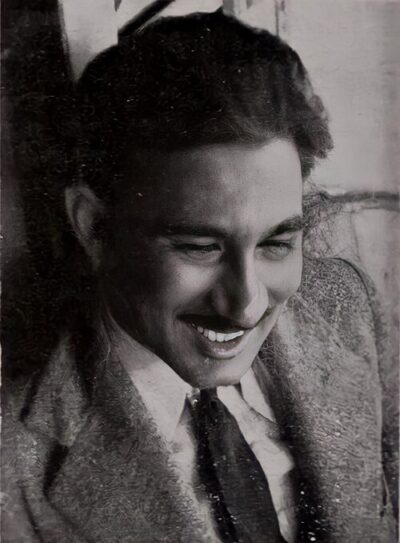
Khwaja Ahmad Abbas
Khwaja Ahmad Abbas was a film director, screenwriter, novelist, and journalist. Born June 7, 1914, in Panipat. Died June 1, 1987, in Mumbai. Educated at Aligarh Muslim University. Awards include Padma Shri in Art.
Facts
20 facts · 2 confirmed by two sources · 5 cited · 13 from one source
Where this comes from
Papalocal keeps its own record. It started from these sources; what each one said is kept here as it was copied, so a change on their side never changes this page by itself. Tap one to read its version.
What Wikidata says · copied November 16, 2026 · revision 2565576558
- Described as
- film director, screenwriter, novelist, and journalist (1914–1987)
- Other names
- K.A. Abbas
- Born
- June 7, 1914 · 2 references
- Died
- June 1, 1987 · 1 reference
- Born in
- Panipat
- Died in
- Mumbai
- Citizen of
- British Raj (–1947); India (1950–)
- Occupation
- film director; screenwriter; journalist; columnist; autobiographer; writer · 1 reference; film producer · 1 reference
- Education
- Aligarh Muslim University
- Awards
- Padma Shri in Art (1969)
- Field
- film direction · 1 reference; film screenwriting · 1 reference; creative and professional writing · 1 reference; journalism · 1 reference
- Religion
- Islam
- Wikipedias with a page
- 42
Wikidata item Q559774 (wikidata.org/wiki/Q559774), public domain (CC0). Copied November 16, 2026.
What Wikipedia says · copied November 16, 2026 · revision 1386034445
Khwaja Ahmad Abbas (7 June 1914 – 1 June 1987) was an Indian film director, screenwriter, novelist, and journalist in Urdu, Hindi and English.
He won four National Film Awards in India. Internationally, his films won the Palme d'Or (Golden Palm Grand Prize) at Cannes Film Festival (out of three Palme d'Or nominations) and the Crystal Globe at Karlovy Vary International Film Festival. As a director and screenwriter, he is considered one of the pioneers of Indian parallel or neo-realistic cinema.
As a director, he made Hindustani films. Dharti Ke Lal (1946), about the Bengal famine of 1943, which was one of Indian cinema's first social-realist films, and opened up the overseas market for Indian films in the Soviet Union. Pardesi (1957) was nominated for the Palme d'Or. Shehar Aur Sapna (1963) won the National Film Award for Best Feature Film, while Saat Hindustani (1969) and Do Boond Pani (1972) both won the National Film Awards for Best Feature Film on National Integration.
As a screenwriter, he wrote a number of neo-realistic films, such as Dharti Ke Lal (which he also directed), Neecha Nagar (1946) which won the Palme d'Or at the first Cannes Film Festival, Naya Sansar (1941), Jagte Raho (1956), and Saat Hindustani (which he also directed). He is also known for writing Raj Kapoor's films, including the Palme d'Or-nominated Awaara (1951), as well as Shree 420 (1955), Mera Naam Joker (1970), Bobby (1973) and Henna (1991).
His column 'Last Page' was one of the longest-running newspaper columns in the history of Indian journalism. It began in 1935, in The Bombay Chronicle, and moved to the Blitz after the Chronicle's closure, where it continued until his death in 1987. He was awarded the Padma Shri by the Government of India in 1969.
In total, his works include 74 books, 90 short stories, 3000 journalistic articles and 40 films.
- Born, in its opening lines
- June 7, 1914
- Died, in its opening lines
- June 1, 1987
From the Wikipedia article “Khwaja Ahmad Abbas” (en.wikipedia.org/wiki/Khwaja_Ahmad_Abbas), by its contributors, under CC BY-SA 4.0 (creativecommons.org/licenses/by-sa/4.0/). Copied November 16, 2026; not changed.
Confirmed Two sources agree. Cited One source, and it names where it got it. One source One source, without a reference of its own. Sources disagree The sources disagree. We show the best-supported value and keep theirs below.
