
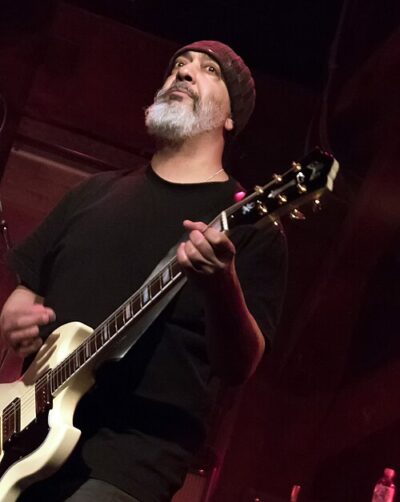
Kim Thayil
Kim Thayil is an American guitarist. Born September 4, 1960, in Seattle. Educated at University of Washington and Rich East High School.
Facts
10 facts · 1 confirmed by two sources · 1 cited · 8 from one source
Where this comes from
Papalocal keeps its own record. It started from these sources; what each one said is kept here as it was copied, so a change on their side never changes this page by itself. Tap one to read its version.
What Wikidata says · copied November 16, 2026 · revision 2566774326
- Described as
- American guitarist
- Other names
- Kim Anand Thayil
- Born
- September 4, 1960
- Born in
- Seattle · 1 reference
- Citizen of
- United States
- Occupation
- guitarist; songwriter
- Education
- University of Washington; Rich East High School · 1 reference
- Member of
- Soundgarden
- Genre
- alternative rock
- Instrument
- guitar
- Wikipedias with a page
- 21
Wikidata item Q464619 (wikidata.org/wiki/Q464619), public domain (CC0). Copied November 16, 2026.
What Wikipedia says · copied November 16, 2026 · revision 1385406798
Kim Anand Thayil (born September 4, 1960) is an American musician best known as the lead guitarist of the Seattle-based rock band Soundgarden, which he co-founded with singer Chris Cornell and bassist Hiro Yamamoto in 1984. Cornell and Thayil remained as the original members of the band until Cornell's death in 2017, and the band's subsequent split in 2018. Thayil was named the 100th greatest guitarist of all time by Rolling Stone in 2010, and the 67th greatest guitarist of all time by SPIN in 2012. Thayil has won two Grammy Awards as a member of Soundgarden.
He was inducted into the Rock and Roll Hall of Fame as a member of Soundgarden in 2025.
- Born, in its opening lines
- September 4, 1960
From the Wikipedia article “Kim Thayil” (en.wikipedia.org/wiki/Kim_Thayil), by its contributors, under CC BY-SA 4.0 (creativecommons.org/licenses/by-sa/4.0/). Copied November 16, 2026; not changed.
Confirmed Two sources agree. Cited One source, and it names where it got it. One source One source, without a reference of its own. Sources disagree The sources disagree. We show the best-supported value and keep theirs below.
