
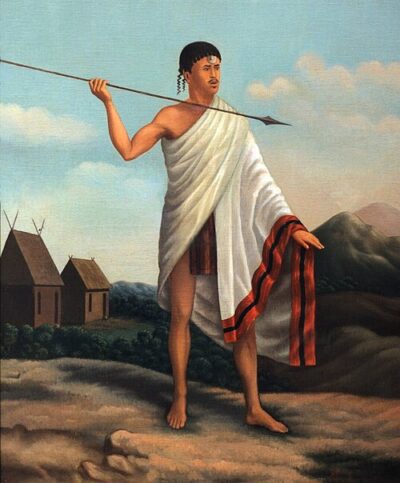
King Andrianampoinimerina
King Andrianampoinimerina was a King of Imerina. Born 1745, in Ambohimanga. Died 1810, in Antananarivo. Positions held include King of Imerina (1787–1810).
Facts
17 facts · 2 confirmed by two sources · 5 cited · 10 from one source
Where this comes from
Papalocal keeps its own record. It started from these sources; what each one said is kept here as it was copied, so a change on their side never changes this page by itself. Tap one to read its version.
What Wikidata says · copied November 16, 2026 · revision 2565574310
- Described as
- King of Imerina
- Other names
- Andrianampoinimerina, Nampoina
- Born
- 1745 · 1 reference
- Died
- 1810
- Born in
- Ambohimanga
- Died in
- Antananarivo
- Buried in
- Ambohimanga · 1 reference
- Citizen of
- Madagascar
- Occupation
- king
- Positions held
- King of Imerina (1787–1810)
- Spouse
- Queen Rambolamasoandro; Miangaly; Rabodonimerina · 1 reference; Ratsimala · 1 reference; Ravaonimerina · 1 reference; Rafotsirahisatra · 1 reference
- Children
- Radama I the Great · 1 reference
- Father
- Andriamiaramanjaka of Anjafy and Kaloy
- Mother
- Ranavalonandriambelomasina
- Wikipedias with a page
- 32
Wikidata item Q218622 (wikidata.org/wiki/Q218622), public domain (CC0). Copied November 16, 2026.
What Wikipedia says · copied November 16, 2026 · revision 1358748261
Andrianampoinimerina (Malagasy pronunciation: [anˈɖʐianˌmpuʲnˈmerʲnə̥]) (c. 1745–1810) ruled the Kingdom of Imerina on Madagascar from 1787 until his death. His reign was marked by the reunification of Imerina following 77 years of civil war, and the subsequent expansion of his kingdom into neighboring territories, thereby initiating the unification of Madagascar under Merina rule. Andrianampoinimerina is a cultural hero and holds near mythic status among the Merina people, and is considered one of the greatest military and political leaders in the history of Madagascar.
Andrianampoinimerina (whose name means "the king in the heart of Imerina") took power upon deposing his uncle, King Andrianjafy, who had ruled over Imerina Avaradrano (Northern Imerina). Prior to Andrianampoinimerina's reign, Imerina Avaradrano had been locked in conflict with the three other neighboring provinces of the former kingdom of Imerina that had last been unified under King Andriamasinavalona a century before. Andrianampoinimerina established his capital at the fortified town of Ambohimanga, a site of great spiritual, cultural and political significance that was designated a UNESCO World Heritage Site in 2001. The king's original royal lodgings can still be visited at Ambohimanga today. From this position, he progressively extended his domain first over all Imerina and then over the greater Highlands, absorbing the Betsileo, Sihanaka, Bezanozano and Bara territories. Having reigned for 23 years at the time of his death, Andrianampoinimerina had successfully reunited Imerina and vastly expanded the Merina kingdom, with the intent to ultimately unify all of Madagascar under Merina rule. His son and heir, Radama I, continued the conquests Andrianampoinimerina had begun, and over the next two decades largely achieved his father's vision.
- Born, in its opening lines
- 1745
- Died, in its opening lines
- 1810
From the Wikipedia article “Andrianampoinimerina” (en.wikipedia.org/wiki/Andrianampoinimerina), by its contributors, under CC BY-SA 4.0 (creativecommons.org/licenses/by-sa/4.0/). Copied November 16, 2026; not changed.
Confirmed Two sources agree. Cited One source, and it names where it got it. One source One source, without a reference of its own. Sources disagree The sources disagree. We show the best-supported value and keep theirs below.
