
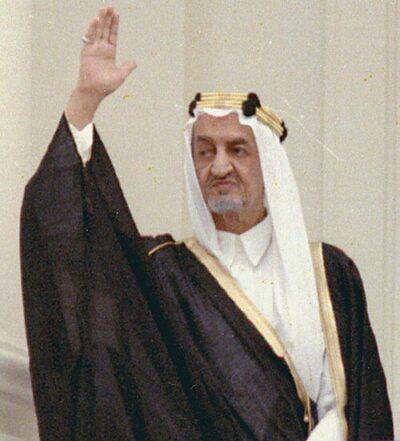
King Faisal bin Abdulaziz Al Saud
King Faisal bin Abdulaziz Al Saud was a King of Saudi Arabia from 1964 to 1975. Born April 14, 1906, in Riyadh. Died March 25, 1975, in Riyadh. Positions held include King of Saudi Arabia (1964–1975), Minister of Foreign Affairs of Saudi Arabia (2 times) (1930–1975) and Prime Minister of Saudi Arabia (1964–1975). Awards include Royal Victorian Chain, Order of King Abdulaziz al Saud and Collar of the Spanish Order of the Civil Merit.
Facts
52 facts · 2 confirmed by two sources · 6 cited · 44 from one source
What’s different
- Born: we show April 14, 1906 (Confirmed). Wikidata also lists 1906
- Died: we show March 25, 1975 (Confirmed). Wikidata also lists 1975
Where this comes from
Papalocal keeps its own record. It started from these sources; what each one said is kept here as it was copied, so a change on their side never changes this page by itself. Tap one to read its version.
What Wikidata says · copied November 16, 2026 · revision 2569305649
- Described as
- King of Saudi Arabia from 1964 to 1975
- Other names
- Faisal of Saudi Arabia, Faisal Bin Abd Al-Aziz Al-Saud, King Faisal bin Abdulaziz Al Saud, King of the Kingdom of Saudi Arabia, Faisal bin Abdulaziz Al Saud, Faisal bin Abdulaziz bin Abdulrahmman al saud
- Born
- April 14, 1906 · 1 reference; 1906 · 1 reference
- Died
- March 25, 1975 · 7 references; 1975 · 1 reference
- Born in
- Riyadh · 2 references
- Died in
- Riyadh · 1 reference
- Buried in
- Al Oud cemetery
- Cause of death
- shooting · 1 reference
- Citizen of
- Saudi Arabia
- Occupation
- monarch; politician · 1 reference; statesperson; military personnel
- Positions held
- King of Saudi Arabia (1964–1975); Minister of Foreign Affairs of Saudi Arabia (2 times) (1930–1975) · 1 reference; Prime Minister of Saudi Arabia (1964–1975) · 1 reference; Minister of Finance (1958–1960) · 1 reference; Crown Prince of Saudi Arabia (1953–1964) · 1 reference
- Awards
- Royal Victorian Chain (1967); Order of King Abdulaziz al Saud; Collar of the Spanish Order of the Civil Merit (1966) · 1 reference; Collar of the Supreme Order of the Chrysanthemum; Knight Grand Cross with Collar of the Order of Merit of the Italian Republic; Order of the Star of Jordan · 1 reference; Financial Times Person of the Year (1973); Member 1st Class of the Order of the Umayyads · 1 reference; Order of Ismail · 1 reference
- Spouse
- Iffat Al-Thunayan (1932–1975)
- Children
- Mohammed bin Faisal Al Saud; Lolowah bint Faisal Al Saud; Turki bin Faisal Al Saud; Abdullah bin Faisal; Khalid bin Faisal Al Saud; Saud bin Faisal bin Abdulaziz Al Saud · 1 reference; Haifa bint Faisal · 1 reference; Sara bint Faisal Al Saud; Saad bin Faisal Al Saud; Bandar Al-Faisal bin Abdulaziz Al Saud; Abdul Rahman Al Faisal
- Father
- Ibn Saud
- Mother
- Tarfah bint Abdullah Al Sheikh
- Siblings
- Fahd bin Abdulaziz Al Saud; Khalid of Saudi Arabia · 1 reference; Saud of Saudi Arabia; Salman bin Abdulaziz Al Saud; Abdullah of Saudi Arabia; Al Jawhara bint Abdulaziz Al Saud; Mamdoh bin Abdulaziz; Mutaib bin Abdulaziz Al Saud; Nura bint Abdulaziz; Latifa bint Abdulaziz Al Saud
- Religion
- Islam
- Military branch
- Saudi Arabian Armed Forces (1919–1933)
- Military rank
- Supreme Commander of all military forces (1964–1975)
- Wikipedias with a page
- 83
Wikidata item Q217167 (wikidata.org/wiki/Q217167), public domain (CC0). Copied November 16, 2026.
What Wikipedia says · copied November 16, 2026 · revision 1382203800
Faisal bin Abdulaziz Al Saud (14 April 1906 – 25 March 1975) was King of Saudi Arabia from 1964 until his assassination in 1975. Before his ascension, he served as Crown Prince of Saudi Arabia from 1953 to 1964, and he was briefly regent to his half-brother King Saud in 1964. He was prime minister from 1954 to 1960 and from 1962 to 1975. Faisal was the third son of King Abdulaziz, the founder of modern Saudi Arabia.
Faisal was born in Riyadh to Abdulaziz, then Emir of Nejd, and Tarfa bint Abdullah Al Sheikh. Faisal's mother was from the Al ash-Sheikh family, which has produced many prominent Saudi religious leaders. Faisal emerged as an influential political figure during his father's reign. He served as viceroy of Hejaz from 1926 to 1932. He was the Saudi foreign minister from 1930 and prime minister from 1954 until his death, except for a two-year break in both positions from 1960 to 1962. After his father died in 1953 and his half-brother Saud became king, Faisal became crown prince, and in that position he outlawed slavery in Saudi Arabia. He persuaded King Saud to abdicate in his favour in 1964 with the help of other members of the royal family and his maternal cousin Muhammad ibn Ibrahim Al ash-Sheikh, Grand Mufti of Saudi Arabia.
Faisal implemented a policy of modernization and reform. His main foreign policy themes were pan-Islamism, anti-communism, anti-Zionism and pro-Palestinianism. He attempted to limit the power of Islamic religious officials. Protesting against support that Israel received from the West, he led the oil embargo which caused the 1973 oil crisis. Faisal successfully stabilized the Kingdom's bureaucracy, and his reign had significant popularity among Saudi Arabians despite his reforms facing some controversy. Following his assassination by his nephew Faisal bin Musaid in 1975, he was succeeded by his half-brother Khalid.
- Born, in its opening lines
- April 14, 1906
- Died, in its opening lines
- March 25, 1975
From the Wikipedia article “Faisal of Saudi Arabia” (en.wikipedia.org/wiki/Faisal_of_Saudi_Arabia), by its contributors, under CC BY-SA 4.0 (creativecommons.org/licenses/by-sa/4.0/). Copied November 16, 2026; not changed.
Confirmed Two sources agree. Cited One source, and it names where it got it. One source One source, without a reference of its own. Sources disagree The sources disagree. We show the best-supported value and keep theirs below.
