
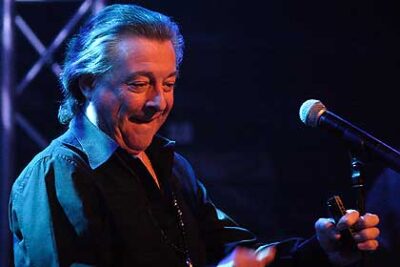
Kirka
Kirka was a Finnish singer. Born September 22, 1950, in Helsinki. Died January 31, 2007, in Helsinki. Awards include Emma Award for Male Artist of the Year and Special Emma.
Facts
23 facts · 2 confirmed by two sources · 1 cited · 20 from one source
Where this comes from
Papalocal keeps its own record. It started from these sources; what each one said is kept here as it was copied, so a change on their side never changes this page by itself. Tap one to read its version.
What Wikidata says · copied November 18, 2026 · revision 2564435498
- Described as
- Finnish singer (1950–2007)
- Other names
- Kirka Babitzin, Kirill Babitzin
- Born
- September 22, 1950 · 2 references
- Died
- January 31, 2007 · 2 references
- Born in
- Helsinki
- Died in
- Helsinki
- Buried in
- Helsinki Orthodox cemetery (2007–)
- Cause of death
- myocardial infarction
- Name at birth
- Kirill Babitzin
- Citizen of
- Finland
- Occupation
- musician · 1 reference; singer
- Member of
- Mestarit
- Genre
- Finnish rock
- Instrument
- accordion; voice
- Awards
- Emma Award for Male Artist of the Year; Special Emma
- Spouse
- Paula Nummela (–2007)
- Children
- Alexandra Babitzin
- Siblings
- Anna Babitzin; Muska; Sammy Babitzin; Ykä Babitzin
- Website
- http://kirka.fi/
- Wikipedias with a page
- 22
Wikidata item Q720971 (wikidata.org/wiki/Q720971), public domain (CC0). Copied November 18, 2026.
What Wikipedia says · copied November 18, 2026 · revision 1376420935
Kirill "Kirka" Babitzin (Russian: Кирилл Бабицын; 22 September 1950 in Helsinki, Finland – 31 January 2007 in Helsinki, Finland) was a Finnish vocalist and musician. One of the most commercially successful artists from Finland, his career lasted from the late 1960s until his death in 2007. Sales of Kirka's records have exceeded one million copies. During his career, Kirka was awarded five Emma prizes.
Kirka's career spanned over four decades with hardly any interruptions. He started his career in 1964 in the band The Creatures, which never published any records. Previously associated with Ilkka Lipsanen's band, The Islanders, Kirka went on to record a wide array of rock and pop music. He went on a solo career in 1967 with his song "Hetki Lyö" (Beat the Clock) in the same year becoming his breakthrough. By the middle 1970s, several hits followed such as "Leijat" (Kites) and "Varrella virran" (Down by the River). His 1988 album Surun Pyyhit Silmistäni (The Sadness in Your Eyes) went on to be one of the best sold records in Finnish history. He also represented Finland in the Eurovision Song Contest 1984 with his song "Hengaillaan" (Hanging Around), with the album of the same name being awarded a gold record. From 1986 to 1987 Kirka published hard rock in English, but soon returned to schlagers in Finnish. In 1988 Kirka won the Syksyn sävel competition with his song "Surun Pyyhit Silmistäni" with the album of the same name being awarded five platinum records. Thus started the most successful part of Kirka's career with numerous gold and platinum records. By the start of the 21st century, Kirka was part of the popular Mestarit ("The Masters") group. His last album was published in 2005.
Kirka's career spanned many different kinds of music. When performing, he sang many rock and soul songs which were his favourite kinds, but his records mostly consisted of softer material. This contradiction sometimes bothered him, and he described himself as a rock singer who performed pop and schlager songs.
Kirka came from a Russo-Finnish background. Of the children in the Babitzin family, Sammy, Muska, Ykä and Anna have also made their careers in the music business. Kirka's daughter Alexandra has also appeared as a singer. Sammy's signature hit Daa-da daa-da tells a story of high-speed automotive cruising.
- Born, in its opening lines
- September 22, 1950
- Died, in its opening lines
- January 31, 2007
From the Wikipedia article “Kirka” (en.wikipedia.org/wiki/Kirka), by its contributors, under CC BY-SA 4.0 (creativecommons.org/licenses/by-sa/4.0/). Copied November 18, 2026; not changed.
Confirmed Two sources agree. Cited One source, and it names where it got it. One source One source, without a reference of its own. Sources disagree The sources disagree. We show the best-supported value and keep theirs below.
