
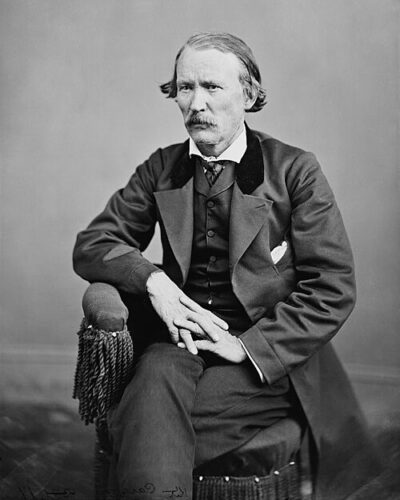
Kit Carson
Kit Carson was an American frontiersman and Union Army general. Born December 24, 1809, in Richmond. Died May 23, 1868, in Fort Lyon.
Facts
11 facts · 2 confirmed by two sources · 1 cited · 8 from one source
Where this comes from
Papalocal keeps its own record. It started from these sources; what each one said is kept here as it was copied, so a change on their side never changes this page by itself. Tap one to read its version.
What Wikidata says · copied November 15, 2026 · revision 2557844094
- Described as
- American frontiersman and Union Army general (1809-1868)
- Other names
- Christopher Carson, Christopher Houston Carson, Christopher Houston "Kit" Carson
- Born
- December 24, 1809 · 5 references
- Died
- May 23, 1868 · 4 references
- Born in
- Richmond
- Died in
- Fort Lyon
- Buried in
- Kit Carson Memorial Cemetery · 1 reference
- Cause of death
- abdominal aortic aneurysm
- Citizen of
- United States
- Occupation
- explorer; military officer
- Military branch
- Union Army
- Military rank
- general
- Wikipedias with a page
- 38
Wikidata item Q379673 (wikidata.org/wiki/Q379673), public domain (CC0). Copied November 15, 2026.
What Wikipedia says · copied November 15, 2026 · revision 1381620214
Christopher Houston Carson (December 24, 1809 – May 23, 1868), popularly known as Kit Carson, was an American frontiersman, fur trapper, wilderness guide, Indian agent and U.S. Army officer.
Carson left home in rural Missouri at 16 to become a mountain man and trapper in the West. In the 1830s, he accompanied Ewing Young on an expedition to Mexican California and joined fur-trapping expeditions into the Rocky Mountains. He lived among and married into the Arapaho and Cheyenne tribes. In the 1840s, Carson was hired as a guide by John C. Frémont, whose expeditions covered much of California, Oregon, and the Great Basin area. Frémont mapped and wrote reports and commentaries on the Oregon Trail to assist and encourage westward-bound pioneers, and Carson achieved national fame through those accounts. Under Frémont's command, Carson participated in the U.S. conquest of California from Mexico, and the Sacramento River massacre and Klamath Lake massacre against Native Americans. Later in the war, Carson was a scout and courier, celebrated for his rescue mission after the Battle of San Pasqual and for his coast-to-coast journey to Washington, D.C., to deliver news of the conflict in California. In the 1850s, he was appointed as the Indian agent to the Ute Indians and the Jicarilla Apaches.
During the American Civil War, Carson led a regiment of mostly Hispanic volunteers from New Mexico on the side of the Union at the Battle of Valverde in 1862. When the Confederate threat was eliminated in New Mexico, Carson led forces to suppress the Navajo, Mescalero Apache, Kiowa, and Comanche tribes by destroying their food sources. Carson oversaw the Long Walk of the Navajo. He was breveted a brigadier general and took command of Fort Garland, Colorado, but poor health soon forced him to retire from military life. Carson was married three times and had ten children. He died at Fort Lyon of an aortic aneurysm on May 23, 1868. He is buried in Taos, New Mexico, next to his third wife, Josefa Carson.
Carson became an American frontier legend in his own lifetime through biographies and news articles; exaggerated versions of his exploits were the subject of dime novels. His understated nature belied confirmed reports of his fearlessness, combat skills, tenacity, as well as profound effect on the westward expansion of the United States. Although he was famous for much of his life, historians in later years have written that Kit Carson did not like, want, or even fully understand the fame that he experienced during his life. During the late nineteenth century, Kit Carson became a legendary symbol of America's frontier experience, which influenced twentieth century erection of statues and monuments, public events and celebrations, imagery by Hollywood, and the naming of geographical places. In the 21st century, Carson's legacy has been contested, particularly due to his brutal treatment of Native Americans.
- Born, in its opening lines
- December 24, 1809
- Died, in its opening lines
- May 23, 1868
From the Wikipedia article “Kit Carson” (en.wikipedia.org/wiki/Kit_Carson), by its contributors, under CC BY-SA 4.0 (creativecommons.org/licenses/by-sa/4.0/). Copied November 15, 2026; not changed.
Confirmed Two sources agree. Cited One source, and it names where it got it. One source One source, without a reference of its own. Sources disagree The sources disagree. We show the best-supported value and keep theirs below.
