
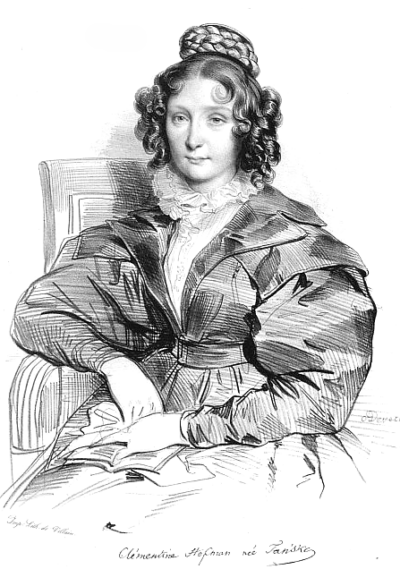
Klementyna Hoffmanowa
Klementyna Hoffmanowa was a Polish novelist, playwright and teacher. Born November 23, 1798, in Warsaw. Died September 21, 1845, in Passy. Known for Wiązanie Helenki, Assarmot and Pamiątka po dobrej matce.
Facts
21 facts · 2 confirmed by two sources · 7 cited · 12 from one source
Where this comes from
Papalocal keeps its own record. It started from these sources; what each one said is kept here as it was copied, so a change on their side never changes this page by itself. Tap one to read its version.
What Wikidata says · copied November 18, 2026 · revision 2557201010
- Described as
- Polish novelist, playwright and teacher (1798–1845)
- Other names
- Klementyna Hoffman, Clementine Hoffman
- Born
- November 23, 1798 · 3 references
- Died
- September 21, 1845 · 3 references
- Born in
- Warsaw · 2 references
- Died in
- Passy · 1 reference
- Buried in
- Père Lachaise Cemetery · 1 reference
- Cause of death
- breast cancer
- Citizen of
- Poland
- Occupation
- translator; children's writer · 1 reference; writer · 1 reference; novelist; playwright; pedagogue · 1 reference
- Worked for
- Rozrywki dla Dzieci · 1 reference
- Known for
- Wiązanie Helenki; Assarmot; Pamiątka po dobrej matce; Dziennik Franciszki Krasińskiej
- Spouse
- Karol Boromeusz Hoffman
- Father
- Ignacy Tański · 1 reference
- Siblings
- Maria Herman
- Wikipedias with a page
- 21
Wikidata item Q433781 (wikidata.org/wiki/Q433781), public domain (CC0). Copied November 18, 2026.
What Wikipedia says · copied November 18, 2026 · revision 1385718455
Klementyna Hoffmanowa, born Klementyna Tańska (23 November 1798 – 21 September 1845) was a Polish novelist, playwright, editor, translator, teacher and activist. She was the first woman in Poland to support herself from writing and teaching, as well as one of Poland's first writers of children's literature.
She made her debut in 1819 with a moralizing treatise A Souvenir After a Good Mother. In the 1820s, she edited a popular magazine for children and published several children books, that have won a wide audience over several generations. She also published a number of novels, including: The Letters of Elżbieta Rzeczycka to her friend Urszula (1824) and, arguably her best known work, The Diary of Countess Françoise Krasinska (1825), translated into several languages, and recounted as one of the first Polish psychological novels.
Hoffmanowa raised the postulate of economic self-empowerment of women. She believed that the first step for women to achieve independence should be gaining education to enable paid work. However, she held conservative views on the role of women and referred to national and Catholic values.
In 1826, her candidacy for membership in the Warsaw Society of Friends of Learning was submitted, but she was not accepted as a woman. She remained unmarried until the age of thirty, long by the standards of her time for a woman, and only in 1829 she married Karol Boromeusz Hoffman. Until then she used her maiden name.
Though writing was her main and most preferred activity and she considered herself primarily a writer, she also worked as a teacher (as an inspector or a visitator) of female schools, and lecturer in moral science at the Governess' Institute in Warsaw (1826–1831). She educated a number of young women, some of whom later became writers and teachers themselves. Hoffmanowa was recalled with respect and appreciation by some of her students; in turn her pupil Narcyza Żmichowska criticized Hoffmanowa's conservatism.
During the November Uprising of Polish people against the Russian Empire, Hoffmanowa was a co-creator and chairman of the Union of Patriotic Charity of the Varsovians and carried the help to the wounded soldiers. After the fall of the uprising in 1831, she and her husband fled to Paris, where their house became a meeting place for Polish political refugees. In Paris, Hoffmanowa was active in the Charity Association of Polish Ladies and the Literary Society, and was called “the Mother of the Great Emigration”. She was friends with Chopin and Mickiewicz.
She died of breast cancer at the age of 46 and was buried at the Père Lachaise Cemetery.
- Born, in its opening lines
- November 23, 1798
- Died, in its opening lines
- September 21, 1845
From the Wikipedia article “Klementyna Hoffmanowa” (en.wikipedia.org/wiki/Klementyna_Hoffmanowa), by its contributors, under CC BY-SA 4.0 (creativecommons.org/licenses/by-sa/4.0/). Copied November 18, 2026; not changed.
Confirmed Two sources agree. Cited One source, and it names where it got it. One source One source, without a reference of its own. Sources disagree The sources disagree. We show the best-supported value and keep theirs below.
