
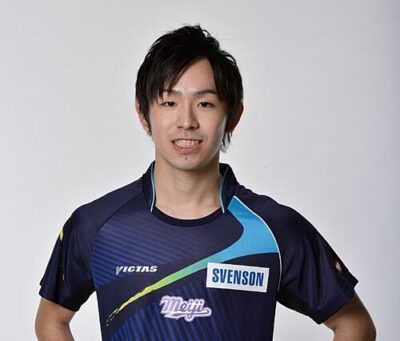
Koki Niwa is a Japanese table tennis player. Born October 10, 1994, in Tomakomai. Teams include Ryukyu Asteeda (2018–2019), Kinoshita Meister Tokyo (2019–2020) and Okayama Rivets (2020–). Educated at Meiji University.
Facts
11 facts · 1 confirmed by two sources · 0 cited · 10 from one source
Where this comes from
Papalocal keeps its own record. It started from these sources; what each one said is kept here as it was copied, so a change on their side never changes this page by itself. Tap one to read its version.
What Wikidata says · copied November 18, 2026 · revision 2518500991
- Described as
- Japanese table tennis player
- Other names
- Kōki Niwa, Kouki Niwa, Niwa Koki, Niwa Kōki, Niwa Kouki
- Born
- October 10, 1994
- Born in
- Tomakomai
- Citizen of
- Japan
- Occupation
- table tennis player · 1 reference
- Education
- Meiji University
- Teams
- Ryukyu Asteeda (2018–2019); Kinoshita Meister Tokyo (2019–2020); Okayama Rivets (2020–); T.T Saitama (2021–2022)
- Sport
- table tennis
- Height
- 1.62 m (5 ft 4 in)
- Wikipedias with a page
- 24
Wikidata item Q1088427 (wikidata.org/wiki/Q1088427), public domain (CC0). Copied November 18, 2026.
What Wikipedia says · copied November 18, 2026 · revision 1366165477
Koki Niwa (丹羽 孝希, Niwa Kōki; born 10 October 1994) is a Japanese male table tennis player. He is the gold medalist at the 2010 Youth Olympics and he won the World Junior Table Tennis Championships in 2010 (doubles) and 2011 (singles).
On 21 April 2012, he defeated Ma Long of China, World Rank no 1, which he became the first player qualified for 2012 Olympics from the Asian Olympic Qualifiers.
Since 2012, he has been playing for the German Team TTC matec Frickenhausen.
He also won the 2014 Russian Open singles title.
- Born, in its opening lines
- October 10, 1994
From the Wikipedia article “Koki Niwa” (en.wikipedia.org/wiki/Koki_Niwa), by its contributors, under CC BY-SA 4.0 (creativecommons.org/licenses/by-sa/4.0/). Copied November 18, 2026; not changed.
Confirmed Two sources agree. Cited One source, and it names where it got it. One source One source, without a reference of its own. Sources disagree The sources disagree. We show the best-supported value and keep theirs below.
