
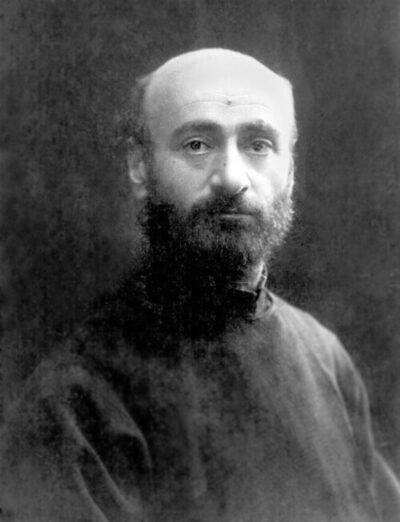
Komitas
Komitas was an Ottoman Armenian priest, musicologist, composer and vardapet. Born September 26, 1869, in Kütahya. Died October 22, 1935, in Paris. Educated at Gevorkian Theological Seminary.
Facts
29 facts · 1 confirmed by two sources · 15 cited · 11 from one source · 2 where the sources disagree
What’s different
- Born: we show September 26, 1869 (Sources disagree). Wikipedia says October 8, 1869
- Name at birth: we show Սողոմոն Գեւորգի Սողոմոնեան (Sources disagree). Wikidata also lists Согомон Геворгій Согомонян
Where this comes from
Papalocal keeps its own record. It started from these sources; what each one said is kept here as it was copied, so a change on their side never changes this page by itself. Tap one to read its version.
What Wikidata says · copied November 16, 2026 · revision 2556349684
- Described as
- Ottoman Armenian priest, musicologist, composer and vardapet (1869–1935)
- Other names
- Soghomon Soghomonyan, Komitas Vardapet
- Born
- September 26, 1869 · 2 references
- Died
- October 22, 1935 · 8 references
- Born in
- Kütahya · 2 references
- Died in
- Paris · 3 references
- Buried in
- Komitas Grave · 1 reference
- Name at birth
- Սողոմոն Գեւորգի Սողոմոնեան; Согомон Геворгій Согомонян
- Citizen of
- Ottoman Empire; Russian Empire; France
- Occupation
- composer · 4 references; ethnomusicologist · 1 reference; musicologist · 2 references; singer · 3 references; conductor · 2 references; choir director · 2 references; music educator · 3 references; vardapet
- Worked for
- Gevorkian Theological Seminary (1893–) · 1 reference
- Education
- Gevorkian Theological Seminary (1881–1893) · 1 reference
- Genre
- Armenian folk music
- Instrument
- voice
- Field
- music · 1 reference; folklore · 1 reference; etnomusicology · 1 reference; music composing · 1 reference; choral conducting · 1 reference; singing · 1 reference
- Religion
- Armenian Apostolic Church
- Website
- https://կոմիտաս.հայ
- Wikipedias with a page
- 56
Wikidata item Q351670 (wikidata.org/wiki/Q351670), public domain (CC0). Copied November 16, 2026.
What Wikipedia says · copied November 16, 2026 · revision 1376475560
Soghomon Soghomonian, ordained and commonly known as Komitas (Armenian: Կոմիտաս; 8 October [O.S. 26 September] 1869 – 22 October 1935), was an Ottoman-Armenian priest, musicologist, composer, arranger, singer, and choirmaster, who is considered the founder of the Armenian national school of music. He is recognized as one of the pioneers of ethnomusicology.
Orphaned at a young age, Komitas was taken to Etchmiadzin, Armenia's religious center, where he received education at the Gevorgian Seminary. Following his ordination as vardapet (celibate priest) in 1895, he studied music at the Frederick William University in Berlin. He thereafter "used his Western training to build a national tradition". He collected and transcribed over 3,000 pieces of Armenian folk music, more than half of which were subsequently lost with only around 1,200 now extant. Besides Armenian folk songs, he also showed interest in other cultures and in 1903 published the first-ever collection of Kurdish folk songs titled Kurdish melodies. His choir presented Armenian music in many European cities, earning the praise of Claude Debussy, among others. Komitas settled in Constantinople in 1910 to escape mistreatment by ultra-conservative clergymen at Etchmiadzin and to introduce Armenian folk music to wider audiences. He was widely embraced by Armenian communities, while Arshag Chobanian called him the "savior of Armenian music".
During the Armenian genocide—along with hundreds of other Armenian intellectuals—Komitas was arrested and deported to a prison camp in April 1915 by the Ottoman government. He was soon released under unclear circumstances and, having witnessed indiscriminate cruelty and relentless massacres of other Armenians by the Ottoman Turks, experienced a mental breakdown and developed a severe case of post-traumatic stress disorder. The widespread hostile environment in Constantinople and reports of mass-scale Armenian death marches and massacres that reached him further worsened his fragile mental state. He was placed in a Turkish military-operated hospital until 1919 and then transferred to psychiatric hospitals in Paris, where he spent the last years of his life in agony. Komitas is widely seen as a martyr of the genocide and has been depicted as one of the main symbols of the Armenian Genocide in art. Collection of Works of the Composer Komitas Vardapet is included to UNESCO Memory of the World Register.
- Born, in its opening lines
- October 8, 1869
- Died, in its opening lines
- October 22, 1935
From the Wikipedia article “Komitas” (en.wikipedia.org/wiki/Komitas), by its contributors, under CC BY-SA 4.0 (creativecommons.org/licenses/by-sa/4.0/). Copied November 16, 2026; not changed.
Confirmed Two sources agree. Cited One source, and it names where it got it. One source One source, without a reference of its own. Sources disagree The sources disagree. We show the best-supported value and keep theirs below.
