
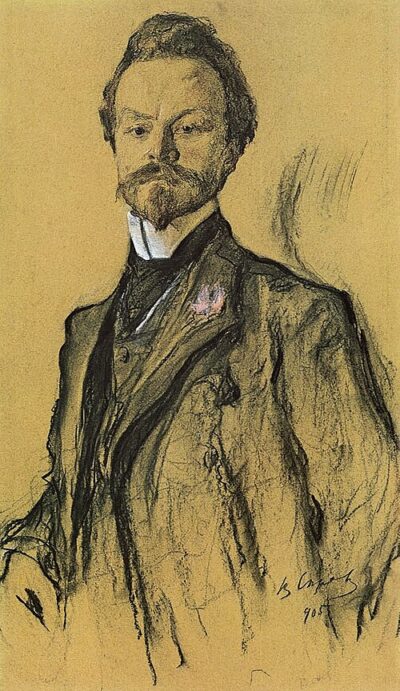
Konstantin Balmont
Konstantin Balmont was a Russian poet. Born June 3, 1867, in Gumnischi. Died December 23, 1942, in Noisy-le-Grand. Known for Burning Buildings and Let Us Be Like the Sun. Educated at Lomonosov Moscow State University.
Facts
28 facts · 1 confirmed by two sources · 10 cited · 16 from one source · 1 where the sources disagree
What’s different
- Born: we show June 3, 1867 (Sources disagree). Wikipedia says June 15, 1867
Where this comes from
Papalocal keeps its own record. It started from these sources; what each one said is kept here as it was copied, so a change on their side never changes this page by itself. Tap one to read its version.
What Wikidata says · copied November 16, 2026 · revision 2570018804
- Described as
- Russian poet (1867–1942)
- Other names
- Konstantin Dmitriyevich Balmont, Balmont
- Born
- June 3, 1867 · 3 references
- Died
- December 23, 1942 · 2 references
- Born in
- Gumnischi
- Died in
- Noisy-le-Grand · 1 reference
- Buried in
- Noisy-le-Grand
- Cause of death
- pneumonia
- Citizen of
- Russian Empire; Russian Soviet Federative Socialist Republic · 1 reference; France · 1 reference
- Occupation
- linguist; poet · 2 references; writer · 1 reference; translator · 1 reference; essayist · 1 reference; translator of Adam Mickiewicz; translator of William Wordsworth
- Education
- Lomonosov Moscow State University
- Genre
- elegy; ballad · 1 reference
- Known for
- Burning Buildings; Let Us Be Like the Sun
- Field
- creative and professional writing · 1 reference; poetry · 1 reference; symbolism · 1 reference; essay · 1 reference; translating activity · 1 reference
- Spouse
- Yekaterina Balmont
- Children
- Nina Balmont
- Wikipedias with a page
- 55
Wikidata item Q314498 (wikidata.org/wiki/Q314498), public domain (CC0). Copied November 16, 2026.
What Wikipedia says · copied November 16, 2026 · revision 1384893196
Konstantin Dmitriyevich Balmont (Russian: Константин Дмитриевич Бальмонт; 15 June [O.S. 3 June] 1867 – 23 December 1942) was a Russian symbolist poet and translator who became one of the major figures of the Silver Age of Russian Poetry.
Balmont's early education came from his mother, who knew several foreign languages, valued literature and theater, and exerted a strong influence on her son. He then attended two gymnasiums, being expelled from the first for political activities and graduating from the second. He started studying law at the Imperial Moscow University in 1886 but was quickly expelled for taking part in student unrest. He tried again at the Demidov Law College from 1889 but dropped out in 1890.
In February 1889, Balmont married Larisa Mikhailovna Garelina. Unhappy in marriage, on 13 March 1890 he attempted suicide by jumping from a third-storey window, resulting in a limp and an injured writing hand for the rest of his life. He became involved in two other common-law marriages and attempted suicide a second time in 1909.
Balmont wrote poetry and prose prolifically and published his works to wide audiences in Imperial Russia. After the Bolshevik revolution he emigrated in 1920 and had a smaller following in exile. He translated the works of other writers, including Edgar Allan Poe. He was thought of among the pre-revolutionary Russian intellectual milieu as an innovative poet and enjoyed friendships with many of his fellow Russian emigrant poets. He died of pneumonia in France in 1942.
- Born, in its opening lines
- June 15, 1867
- Died, in its opening lines
- December 23, 1942
From the Wikipedia article “Konstantin Balmont” (en.wikipedia.org/wiki/Konstantin_Balmont), by its contributors, under CC BY-SA 4.0 (creativecommons.org/licenses/by-sa/4.0/). Copied November 16, 2026; not changed.
Confirmed Two sources agree. Cited One source, and it names where it got it. One source One source, without a reference of its own. Sources disagree The sources disagree. We show the best-supported value and keep theirs below.
