
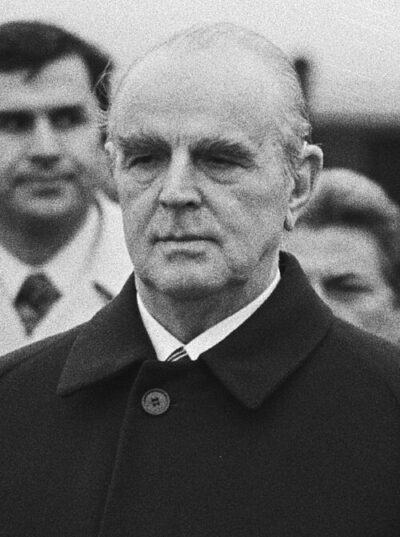
Konstantinos Karamanlis
Konstantinos Karamanlis was a Greek politician and lawyer (1907–1998), Prime Minister of Greece intermittently between 1955–80, President from 1980–85, 1990–95. Born March 8, 1907, in Proti. Died April 23, 1998, in Hygeia Hospital. Positions held include Prime Minister of Greece (2 times) (1955–1980), President of Greece (2 times) (1980–1995) and member of the Hellenic Parliament (1935–1936). Educated at National and Kapodistrian University of Athens. Awards include Charlemagne Prize, Robert Schuman Medal and Grand Cross of the Order of Isabella the Catholic.
Facts
41 facts · 2 confirmed by two sources · 6 cited · 33 from one source
Where this comes from
Papalocal keeps its own record. It started from these sources; what each one said is kept here as it was copied, so a change on their side never changes this page by itself. Tap one to read its version.
What Wikidata says · copied November 16, 2026 · revision 2570039786
- Described as
- Greek politician and lawyer (1907–1998), Prime Minister of Greece intermittently between 1955–80, President from 1980–85, 1990–95
- Other names
- Konstantin Karamanlis
- Born
- March 8, 1907 · 3 references
- Died
- April 23, 1998 · 8 references
- Born in
- Proti · 1 reference
- Died in
- Hygeia Hospital · 1 reference
- Buried in
- Konstantinos Karamanlis Foundation
- Citizen of
- Greece
- Occupation
- politician; lawyer
- Positions held
- Prime Minister of Greece (2 times) (1955–1980); President of Greece (2 times) (1980–1995); member of the Hellenic Parliament (1935–1936) · 1 reference; Minister of Public Works (1952–1955); substitute member of the Parliamentary Assembly of the Council of Europe (1989–1991) · 1 reference; President of the New Democracy (1974–1980)
- Political party
- People's Party; New Democracy; Greek Rally; National Radical Union
- Education
- National and Kapodistrian University of Athens
- Member of
- Parliamentary Assembly of the Council of Europe; Friends of Music Society
- Awards
- Charlemagne Prize (1978) · 1 reference; Robert Schuman Medal (1986); Grand Cross of the Order of Isabella the Catholic · 1 reference; Bavarian Order of Merit; Great Cross with Star and Sash of the Order of Merit of the Federal Republic of Germany; Grand Cross 1st class of the Order of Merit of the Federal Republic of Germany; Knight Grand Cross with Collar of the Order of Merit of the Italian Republic; Knight Grand Cross of the Order of Merit of the Italian Republic; Grand Cross of the Order of the Holy Lamb (1991) · 1 reference
- Spouse
- Amalia Megapanou (1951–1972) · 1 reference
- Father
- Georgios Karamanlis
- Mother
- Foteini Dologlou
- Siblings
- Olga Karamanlis; Athena Karamanlis; Achilleas Karamanlis; Gramménos Karamanlís; Alekos Karamanlis; Antigone Karamanlis; Athina Karamanli
- Religion
- Eastern Orthodox Church
- Wikipedias with a page
- 53
Wikidata item Q156806 (wikidata.org/wiki/Q156806), public domain (CC0). Copied November 16, 2026.
What Wikipedia says · copied November 16, 2026 · revision 1379202979
Konstantinos G. Karamanlis (Greek: Κωνσταντίνος Γ. Καραμανλής, pronounced [konstaˈdinos karamanˈlis]; 8 March 1907 – 23 April 1998) was a Greek statesman who was the four-time Prime Minister of Greece and two-term president of the Third Hellenic Republic, serving in the former role from 1955 to 1963 and from 1974 to 1980. A towering figure of Greek politics, his political career spanned portions of seven decades, covering much of the latter half of the 20th century.
Born near Serres in Macedonia, Karamanlis practiced law until his election to the Hellenic Parliament in 1936 as a member of the conservative People's Party. Rising through the ranks of Greek politics after World War II, Karamanlis became Minister of Labour in 1947, and in 1952 he was named Minister for Public Works in Alexandros Papagos's Greek Rally administration. He was appointed prime minister by King Paul of Greece after Papagos's death in 1955. During his first term, he applied a program of rapid industrialization, heavy investment on infrastructure and improvement on agricultural production, which led to the post-war Greek economic miracle. He also implemented the extension of full voting rights to women, which had stood dormant since 1952. In foreign affairs, he pursued an aggressive policy toward Greek membership in the European Economic Community (EEC), and abandoned the government's previous strategic goal for enosis (the unification of Greece and Cyprus) in favour of Cypriot independence. Re-elected three times, electoral victories in 1956 and 1961 were marred by controversy and political division.
In 1963, Karamanlis resigned following a disagreement with King Paul amidst spiralling political crises in Greece. He spent the next eleven years in self-imposed exile in Paris, resigning from the leadership of the National Radical Union after defeat in the 1963 elections, while the country fell under military dictatorship after the 1967 coup d'état. After the fall of the junta in 1974, Karamanlis was recalled to Athens to assume interim premiership. This period, known as the Metapolitefsi, saw the country's transition to a pluralist democracy, which resulted in the decriminalisation of the Communist Party. His new party, New Democracy, won a commanding victory in the November 1974 elections, which were followed by a plebiscite that abolished the monarchy and established the Third Hellenic Republic.
In 1980, Karamanlis resigned as prime minister and was elected President of the Republic. In 1981, he oversaw Greece's formal entry into the European Economic Community. He resigned from the presidency in 1985 but was again elected in 1990, and served until his retirement from active politics in 1995. Karamanlis died in 1998 at the age of 91.
- Born, in its opening lines
- March 8, 1907
- Died, in its opening lines
- April 23, 1998
From the Wikipedia article “Konstantinos Karamanlis” (en.wikipedia.org/wiki/Konstantinos_Karamanlis), by its contributors, under CC BY-SA 4.0 (creativecommons.org/licenses/by-sa/4.0/). Copied November 16, 2026; not changed.
Confirmed Two sources agree. Cited One source, and it names where it got it. One source One source, without a reference of its own. Sources disagree The sources disagree. We show the best-supported value and keep theirs below.
