
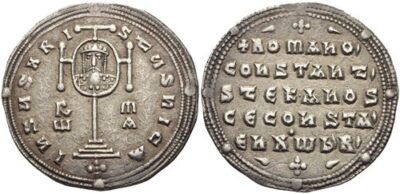
Konstantinos Lekapenos
Konstantinos Lekapenos was a Byzantine emperor. Died 950s, in Samothrace. Positions held include Byzantine emperor.
Facts
12 facts · 0 confirmed by two sources · 0 cited · 11 from one source · 1 where the sources disagree
What’s different
- Died: we show 950s (Sources disagree). Wikipedia says 944
Where this comes from
Papalocal keeps its own record. It started from these sources; what each one said is kept here as it was copied, so a change on their side never changes this page by itself. Tap one to read its version.
What Wikidata says · copied November 18, 2026 · revision 2554175018
- Described as
- Byzantine emperor
- Died
- 950s
- Born in
- Constantinople
- Died in
- Samothrace
- Citizen of
- Byzantine Empire
- Occupation
- monarch
- Positions held
- Byzantine emperor
- Father
- Romanos I Lekapenos
- Mother
- Theodora
- Siblings
- Christopher Lekapenos; Stephen Lekapenos; Theophylact of Constantinople; Helena Lekapene
- Wikipedias with a page
- 24
Wikidata item Q1281912 (wikidata.org/wiki/Q1281912), public domain (CC0). Copied November 18, 2026.
What Wikipedia says · copied November 18, 2026 · revision 1386246521
Constantine Lekapenos or Lecapenus (Ancient Greek: Κωνσταντῖνος Λακαπηνός or Λεκαπηνός, romanized: Kōnstantīnos Lakapēnos or Lekapēnos) was the third son of the Byzantine emperor Romanos I Lekapenos (r. 920–944), and co-emperor from 924 to 945. With his elder brother Stephen, he deposed Romanos I in December 944, but was overthrown and exiled by the co-emperor Constantine VII (r. 913–959) a few weeks later. Constantine Lekapenos was exiled to the island of Samothrace, where he was killed while attempting to escape sometime between 946 and 948.
- Born, in its opening lines
- 920
- Died, in its opening lines
- 944
From the Wikipedia article “Constantine Lekapenos” (en.wikipedia.org/wiki/Constantine_Lekapenos), by its contributors, under CC BY-SA 4.0 (creativecommons.org/licenses/by-sa/4.0/). Copied November 18, 2026; not changed.
Confirmed Two sources agree. Cited One source, and it names where it got it. One source One source, without a reference of its own. Sources disagree The sources disagree. We show the best-supported value and keep theirs below.
