
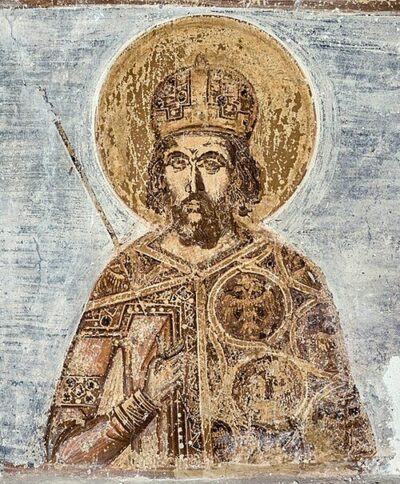
Konstantinos XI Palaiologos
Konstantinos XI Palaiologos was a last Byzantine emperor, from 1449 to 1453. Born February 8, 1404, in Constantinople. Died May 29, 1453, in Constantinople. Positions held include Byzantine emperor (1449–1453) and Despot of the Morea.
Facts
18 facts · 2 confirmed by two sources · 3 cited · 13 from one source
Where this comes from
Papalocal keeps its own record. It started from these sources; what each one said is kept here as it was copied, so a change on their side never changes this page by itself. Tap one to read its version.
What Wikidata says · copied November 16, 2026 · revision 2569181567
- Described as
- last Byzantine emperor, from 1449 to 1453
- Other names
- Constantine XI Dragases Palaiologos, Constantine XI Dragases Palaeologus, Emperor of Constantinople, Constantine XI Palaiologos, Marmaroménos Vasiliás
- Born
- February 8, 1404 · 1 reference
- Died
- May 29, 1453 · 4 references
- Born in
- Constantinople · 1 reference
- Died in
- Constantinople · 1 reference
- Citizen of
- Byzantine Empire
- Positions held
- Byzantine emperor (1449–1453); Despot of the Morea
- Spouse
- Theodora Tocco (1428–); Caterina Gattilusio (1441–1442)
- Father
- Manuel II Palaiologos · 1 reference
- Mother
- Helena Dragaš
- Siblings
- Demetrios Palaiologos; Andronikos Palaiologos, Lord of Thessalonica; John VIII Palaiologos; Thomas Palaiologos; Theodoros II Palaiologos
- Religion
- Eastern Orthodoxy · 1 reference; Catholicism · 1 reference
- Wikipedias with a page
- 76
Wikidata item Q37142 (wikidata.org/wiki/Q37142), public domain (CC0). Copied November 16, 2026.
What Wikipedia says · copied November 16, 2026 · revision 1384994038
Constantine XI Dragases Palaiologos or Dragaš Palaeologus (Greek: Κωνσταντῖνος Δραγάσης Παλαιολόγος, romanized: Kōnstantīnos Dragásēs Palaiológos; 8 February 1404 – 29 May 1453) was the last reigning Byzantine emperor from 23 January 1449 until his death in battle at the fall of Constantinople on 29 May 1453. Constantine's death marked the definitive end of the Eastern Roman Empire, which traced its origin to Constantine the Great's foundation of Constantinople as the Roman Empire's new capital in 330.
Constantine was the fourth son of Emperor Manuel II Palaiologos and Serbian noblewoman Helena Dragaš. Little is known of his early life, but from the 1420s onward, he repeatedly demonstrated great skill as a military general. Based on his career and surviving contemporary sources, Constantine appears to have been primarily a soldier. This does not mean that Constantine was not also a skilled administrator: he was trusted and favored to such an extent by his older brother, Emperor John VIII Palaiologos, that he was designated as regent twice during John VIII's journeys away from Constantinople in 1423–1424 and 1437–1440. In 1427–1428, Constantine and John fended off an attack on the Morea (the Peloponnese) by Carlo I Tocco, ruler of Epirus, and in 1428 Constantine was proclaimed Despot of the Morea and ruled the province together with his older brother Theodore and his younger brother Thomas. Together, they extended Roman rule to cover almost the entire Peloponnese for the first time since the Fourth Crusade more than 200 years before and rebuilt the ancient Hexamilion wall, which defended the peninsula from outside attacks. Although ultimately unsuccessful, Constantine personally led a campaign into Central Greece and Thessaly in 1444–1446, attempting to extend Byzantine rule into Greece once more.
In October 1448, John VIII died without children, and as his favored successor, Constantine was proclaimed emperor on 6 January 1449. During his reign, Constantine would have to deal with three main issues. First, there was the issue of an heir, as Constantine was childless; although his friend and confidant George Sphrantzes tried to find him a wife, Constantine died unmarried. The second concern was religious conflict within what little remained of the empire; like John VIII, Constantine supported the reunion between the Greek Orthodox and Catholic Churches proclaimed at the Council of Florence and sought military aid from Catholic Europe, which was unforthcoming. Finally, the most important concern was the growing Ottoman Empire; in April 1453, the Ottoman sultan Mehmed II led an army of perhaps 80,000 men against Constantinople, defended by probably less than 10,000 soldiers, ending with its fall on 29 May 1453. Constantine died in battle on the following day. Although no reliable eyewitness accounts of his death survived, most historical accounts agree that the emperor died fighting in a last stand against the Ottomans.
Constantine was the last Christian ruler of Constantinople, which alongside his bravery at the city's fall cemented him as a near-legendary figure in later histories and Greek folklore. Some saw the foundation of Constantinople (the New Rome) under Constantine the Great and its loss under another Constantine as fulfillment of the city's destiny, just as Old Rome had been founded by a Romulus and lost under another, Romulus Augustulus. He became known in later Greek folklore as "The Marble Emperor" (Greek: Μαρμαρωμένος Βασιλιάς, Marmaroménos Vasiliás lit. 'Emperor turned into Marble'), reflecting a popular legend that Constantine had not actually died, but had been rescued by an angel and turned into marble, hidden beneath the Golden Gate of Constantinople awaiting a call from God to be restored to life and reconquer both the city and the old empire.
- Born, in its opening lines
- February 8, 1404
- Died, in its opening lines
- May 29, 1453
From the Wikipedia article “Constantine XI Palaiologos” (en.wikipedia.org/wiki/Constantine_XI_Palaiologos), by its contributors, under CC BY-SA 4.0 (creativecommons.org/licenses/by-sa/4.0/). Copied November 16, 2026; not changed.
Confirmed Two sources agree. Cited One source, and it names where it got it. One source One source, without a reference of its own. Sources disagree The sources disagree. We show the best-supported value and keep theirs below.
