
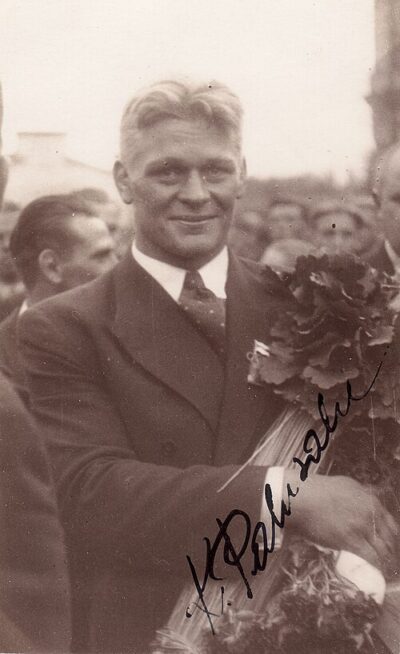
Kristjan Palusalu
Kristjan Palusalu was an Estonian wrestler. Born March 10, 1908, in Saulepi Rural Municipality. Died July 17, 1987, in Tallinn.
Facts
13 facts · 2 confirmed by two sources · 4 cited · 7 from one source
Where this comes from
Papalocal keeps its own record. It started from these sources; what each one said is kept here as it was copied, so a change on their side never changes this page by itself. Tap one to read its version.
What Wikidata says · copied November 17, 2026 · revision 2559363564
- Described as
- Estonian wrestler (1908–1987)
- Other names
- Kristjan Trossmann
- Born
- March 10, 1908 · 1 reference
- Died
- July 17, 1987 · 1 reference
- Born in
- Saulepi Rural Municipality · 1 reference
- Died in
- Tallinn · 1 reference
- Buried in
- Metsakalmistu
- Citizen of
- Estonia; Soviet Union
- Occupation
- amateur wrestler; military personnel · 1 reference; civil servant; athlete · 1 reference
- Sport
- amateur wrestling
- Height
- 1.85 m (6 ft 1 in) · 2 references
- Wikipedias with a page
- 25
Wikidata item Q1789405 (wikidata.org/wiki/Q1789405), public domain (CC0). Copied November 17, 2026.
What Wikipedia says · copied November 17, 2026 · revision 1379531038
Kristjan Palusalu (until 1935 Kristjan Trossmann, 10 March [O.S. 26 February] 1908 – 17 July 1987) was an Estonian heavyweight wrestler and Olympic winner. Palusalu became the first and only wrestler in Olympic history ever to win both the Greco-Roman and freestyle heavyweight events.
Palusalu was born in Varemurru village, Saulepi Parish, Lääne County (now Matsi village, Lääneranna Parish, Pärnu County) as one of eight children to Jüri and Liisu Trossmann. He is best remembered for winning two gold medals at the 1936 Summer Olympics in Berlin. He was given the honor of carrying the Estonian flag to the Olympiastadion. The triumph was celebrated across Estonia with Palusalu and other Estonian athletes touring the country by rail giving speeches. A third of the inhabitants of Tallinn turned out to greet him and the Estonian government granted him a farm.
After the Soviet Union occupied Estonia in 1940, Palusalu was sent to hard labour in Kotlas, Russia in 1941. He tried to escape with other prisoners but was captured after a few days. He was then sentenced to death together with his fellow fugitives but was given the chance to go to the front line to fight against Finland in the Continuation War. He deserted to the Finnish side in Northern Karelia, northwest of Lake Onega. According to one Finnish soldier, Mr. Suuperko, Palusalu and his friends shouted "Finnish boys do not shoot Estonians", when they crossed the lines. Palusalu was soon recognized by a person in the Finnish army, who had sports background (Heikki Savolainen).
He was imprisoned, but then was allowed to return to his homeland, which was then under German occupation. After the return of the Soviet army in 1945 he was arrested again, but was later allowed to work as a trainer and a referee, he also participated in some competitions in Estonia. He was not forgotten by the Estonian people. As one of the most popular sportsmen in Estonia throughout history, Kristjan Palusalu is one of the few who have become synonymous with the Estonian nation itself.
Palusalu was married to Ellen Saidla. The couple had a son, Jüri Palusalu.
- Born, in its opening lines
- March 10, 1908
- Died, in its opening lines
- July 17, 1987
From the Wikipedia article “Kristjan Palusalu” (en.wikipedia.org/wiki/Kristjan_Palusalu), by its contributors, under CC BY-SA 4.0 (creativecommons.org/licenses/by-sa/4.0/). Copied November 17, 2026; not changed.
Confirmed Two sources agree. Cited One source, and it names where it got it. One source One source, without a reference of its own. Sources disagree The sources disagree. We show the best-supported value and keep theirs below.
