
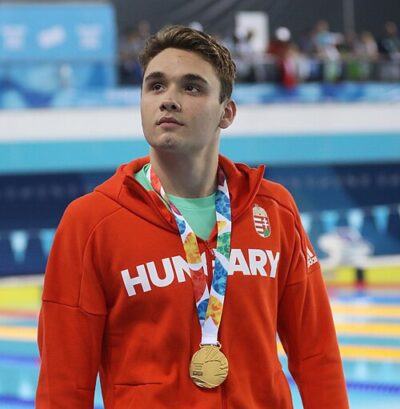
Kristóf Milák
Kristóf Milák is a Hungarian swimmer. Born February 20, 2000, in Budapest. Teams include Team Iron and Budapesti Honvéd SE.
Facts
8 facts · 1 confirmed by two sources · 1 cited · 6 from one source
Where this comes from
Papalocal keeps its own record. It started from these sources; what each one said is kept here as it was copied, so a change on their side never changes this page by itself. Tap one to read its version.
What Wikidata says · copied November 16, 2026 · revision 2516491647
- Described as
- Hungarian swimmer
- Other names
- Milák Kristóf
- Born
- February 20, 2000
- Born in
- Budapest · 1 reference
- Citizen of
- Hungary
- Occupation
- swimmer · 1 reference
- Teams
- Team Iron; Budapesti Honvéd SE
- Sport
- competitive swimming · 1 reference
- Height
- 1.90 m (6 ft 3 in) · 1 reference
- Wikipedias with a page
- 30
Wikidata item Q26262055 (wikidata.org/wiki/Q26262055), public domain (CC0). Copied November 16, 2026.
What Wikipedia says · copied November 16, 2026 · revision 1380325022
Kristóf Milák (born 20 February 2000) is a Hungarian professional swimmer. He is the current holder of the world record in the long course 200 metre butterfly and the European record in the long course 100 metre butterfly. At his first Olympic Games, the 2020 Summer Olympics, he won a gold medal in the 200 metre butterfly and a silver medal in the 100 metre butterfly. He has also won three gold medals and one silver at the World Aquatic Championships, as well as three gold medals at the European Aquatics Championships. He was the gold medalist in the 400 metre freestyle, 200 metre freestyle, and 200 metre butterfly events at the 2018 Summer Youth Olympics.
- Born, in its opening lines
- February 20, 2000
From the Wikipedia article “Kristóf Milák” (en.wikipedia.org/wiki/Kristóf_Milák), by its contributors, under CC BY-SA 4.0 (creativecommons.org/licenses/by-sa/4.0/). Copied November 16, 2026; not changed.
Confirmed Two sources agree. Cited One source, and it names where it got it. One source One source, without a reference of its own. Sources disagree The sources disagree. We show the best-supported value and keep theirs below.
