
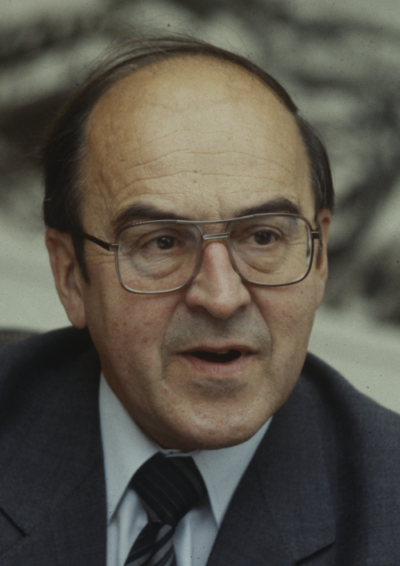
Kurt Furgler
Kurt Furgler was a Swiss politician. Born June 24, 1924, in St. Gallen. Died July 23, 2008, in St. Gallen. Positions held include Member of the Swiss Federal Council (1971–1986), Member of the Swiss National Council (1954–1971) and President of the Swiss Confederation (3 times) (1977–1985). Educated at University of Fribourg and University of Zurich.
Facts
18 facts · 2 confirmed by two sources · 8 cited · 8 from one source
Where this comes from
Papalocal keeps its own record. It started from these sources; what each one said is kept here as it was copied, so a change on their side never changes this page by itself. Tap one to read its version.
What Wikidata says · copied November 18, 2026 · revision 2568873897
- Described as
- Swiss politician (1924-2008)
- Born
- June 24, 1924 · 4 references
- Died
- July 23, 2008 · 4 references
- Born in
- St. Gallen · 1 reference
- Died in
- St. Gallen · 1 reference
- Buried in
- Ostfriedhof
- Cause of death
- heart failure
- Citizen of
- Switzerland · 1 reference
- Occupation
- politician · 1 reference
- Positions held
- Member of the Swiss Federal Council (1971–1986) · 1 reference; Member of the Swiss National Council (1954–1971) · 1 reference; President of the Swiss Confederation (3 times) (1977–1985); Representative of the Parliamentary Assembly of the Council of Europe (1968–1972) · 1 reference
- Political party
- Christian Democratic People's Party
- Education
- University of Fribourg; University of Zurich · 1 reference
- Member of
- AV Welfen
- Religion
- Catholicism · 2 references
- Military rank
- brigadier
- Wikipedias with a page
- 21
Wikidata item Q115600 (wikidata.org/wiki/Q115600), public domain (CC0). Copied November 18, 2026.
What Wikipedia says · copied November 18, 2026 · revision 1378164319
Kurt Furgler (24 June 1924 – 23 July 2008) was a Swiss politician and member of the Swiss Federal Council (1972–1986).
He was elected to the Federal Council of Switzerland on 8 December 1971 and handed over office on 31 December 1986. He was affiliated to the Christian Democratic People's Party of Switzerland.
During his office time he held the following departments:Federal Department of Justice and Police (1972–1982)
Federal Department of Economic Affairs (1983–1986)
He was President of the Confederation three times in 1977, 1981 and 1985.
Kurt Furgler was born and raised in St. Gallen, Switzerland. He studied Jurisprudence in Fribourg, Zürich, and Geneva, and was an avid handball player during his youth. In 1948, he obtained his license to practice law in St. Gallen. As a conservative centrist in the Federal Council of Switzerland, he advocated equal rights for women, and initiated economic reforms and modernized immigration and Swiss family law.
During his presidency, he argued for the European integration of Switzerland, and in 1982, signed the Luxembourg Declaration, which called for a closer cooperation between the European Union and the European Free Trade Association (EFTA). Dr. Furgler demanded a strong central government but failed to establish a Swiss federal police due to strong opposition from the left and confederated forces of the right.
In September 1982, he was the head of the special task force for the hostage situation in the Polish embassy in Bern. Controversially, he approved the clandestine copying of Polish diplomatic documents.
In November 1985, he asserted his significant representative role in international relations when he welcomed the American president Ronald Reagan and General Secretary of the Communist Party of the Soviet Union Mikhail Gorbachev at the Geneva Summit.
Kurt Furgler resigned unexpectedly in 1986, but continued to serve in a number of committees, including the Club of Rome, InterAction Council, and the International Olympic Committee.
- Born, in its opening lines
- June 24, 1924
- Died, in its opening lines
- July 23, 2008
From the Wikipedia article “Kurt Furgler” (en.wikipedia.org/wiki/Kurt_Furgler), by its contributors, under CC BY-SA 4.0 (creativecommons.org/licenses/by-sa/4.0/). Copied November 18, 2026; not changed.
Confirmed Two sources agree. Cited One source, and it names where it got it. One source One source, without a reference of its own. Sources disagree The sources disagree. We show the best-supported value and keep theirs below.
