
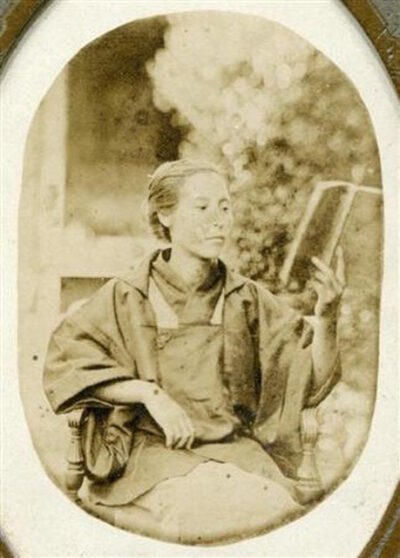
Kusumoto Ine
Kusumoto Ine was the first female doctor of Western medicine in Japan. Born May 31, 1827, in Dejima. Died August 26, 1903, in Azabu.
Facts
17 facts · 1 confirmed by two sources · 8 cited · 6 from one source · 2 where the sources disagree
What’s different
- Died: we show August 26, 1903 (Sources disagree). Wikipedia says August 27, 1903
- Born in: we show Dejima (Sources disagree). Wikidata also lists Nagasaki
Where this comes from
Papalocal keeps its own record. It started from these sources; what each one said is kept here as it was copied, so a change on their side never changes this page by itself. Tap one to read its version.
What Wikidata says · copied November 17, 2026 · revision 2567901351
- Described as
- the first female doctor of Western medicine in Japan
- Other names
- Shiimoto Ine, Oine
- Born
- May 31, 1827 · 2 references
- Died
- August 26, 1903 · 2 references
- Born in
- Dejima · 1 reference; Nagasaki · 1 reference
- Died in
- Azabu · 1 reference
- Buried in
- Kōtai-ji Temple
- Citizen of
- Japan
- Occupation
- physician · 1 reference; midwife · 2 references; gynecologist · 2 references
- Children
- Takako Kusumoto
- Father
- Philipp Franz von Siebold · 1 reference
- Mother
- Kusumoto Taki · 1 reference
- Siblings
- Heinrich von Siebold · 1 reference; Alexander von Siebold · 1 reference; Helene von Siebold · 1 reference; Mathilde von Siebold · 1 reference; Maximilian von Siebold · 1 reference
- Wikipedias with a page
- 25
Wikidata item Q449696 (wikidata.org/wiki/Q449696), public domain (CC0). Copied November 17, 2026.
What Wikipedia says · copied November 17, 2026 · revision 1374717791
Kusumoto Ine (楠本 イネ, 31 May 1827 – 27 August 1903; born Shiimoto Ine 失本 稲) was a Japanese physician. She was the first female doctor of Western medicine in Japan.
She was the daughter of Kusumoto Taki, who was a courtesan from Nagasaki; and the German physician Philipp Franz von Siebold, who worked on Dejima, an island to which foreigners were restricted during Japan's long period of seclusion from the world. Later in life she took the name Itoku (伊篤), and is often called Oranda O-Ine ("Dutch O-Ine") for her association with Dejima and its Dutch language-based Western learning.
Siebold was banished from Japan in 1829 but managed to provide for Ine and her mother and arranged for his students and associates to care for them. Ine's reputation grew after she became a doctor of Western medicine, and she won the patronage of the feudal lord Date Munenari. She studied in various parts of Japan under numerous teachers, one of whom impregnated her—likely having raped her—resulting in her only daughter; she never married. She settled in Tokyo after the country ended its seclusion, and assisted in the birth by one of Emperor Meiji's concubines in 1873. Since her death Ine has been the subject of novels, plays, comics, and musicals in Japan.
- Born, in its opening lines
- May 31, 1827
- Died, in its opening lines
- August 27, 1903
From the Wikipedia article “Kusumoto Ine” (en.wikipedia.org/wiki/Kusumoto_Ine), by its contributors, under CC BY-SA 4.0 (creativecommons.org/licenses/by-sa/4.0/). Copied November 17, 2026; not changed.
Confirmed Two sources agree. Cited One source, and it names where it got it. One source One source, without a reference of its own. Sources disagree The sources disagree. We show the best-supported value and keep theirs below.
