
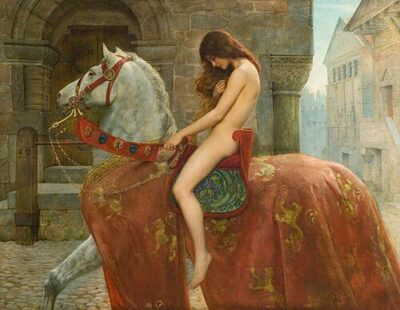
Lady Godiva
Lady Godiva was an Anglo-Saxon noblewoman, Countess of Leicester. Born 990. Died September 10, 1067, in Kingdom of England.
Facts
7 facts · 0 confirmed by two sources · 5 cited · 2 from one source
Where this comes from
Papalocal keeps its own record. It started from these sources; what each one said is kept here as it was copied, so a change on their side never changes this page by itself. Tap one to read its version.
What Wikidata says · copied November 16, 2026 · revision 2560384158
- Described as
- Anglo-Saxon noblewoman, Countess of Leicester
- Other names
- Godiva, Godiva, Countess of Leicester, Godiva (?), Godgifu
- Born
- 990 · 1 reference
- Died
- September 10, 1067 · 1 reference
- Died in
- Kingdom of England · 1 reference
- Buried in
- Coventry · 1 reference
- Citizen of
- Kingdom of England
- Spouse
- Leofric, Earl of Mercia · 2 references
- Children
- Ælfgar · 2 references
- Wikipedias with a page
- 58
Wikidata item Q106077 (wikidata.org/wiki/Q106077), public domain (CC0). Copied November 16, 2026.
What Wikipedia says · copied November 16, 2026 · revision 1384123699
Lady Godiva (; died between 1066 and 1086), in Old English Gōdgifu, was a late Anglo-Saxon noblewoman who is relatively well documented as the wife of Leofric, Earl of Mercia, and a patron of various churches and monasteries.
She is mainly remembered for a legend dating back to at least the 13th century, in which she rode naked – covered only by her long hair – through the streets of Coventry to gain a remission of the oppressive taxation that her husband, Leofric, imposed on his tenants. The name "Peeping Tom" for a voyeur originates from later versions of this legend, in which a man named Thomas watched her ride and was struck blind or dead.
From the Wikipedia article “Lady Godiva” (en.wikipedia.org/wiki/Lady_Godiva), by its contributors, under CC BY-SA 4.0 (creativecommons.org/licenses/by-sa/4.0/). Copied November 16, 2026; not changed.
Confirmed Two sources agree. Cited One source, and it names where it got it. One source One source, without a reference of its own. Sources disagree The sources disagree. We show the best-supported value and keep theirs below.
