
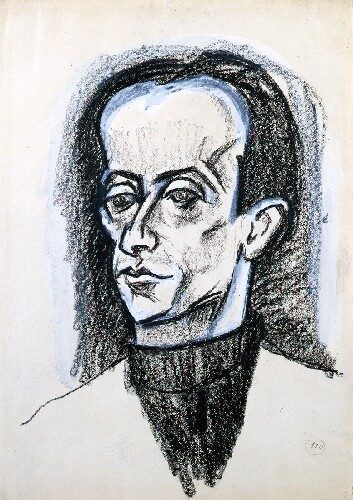
Lajos Kassák
Lajos Kassák was a Hungarian artist, poet, writer, politician. Born March 21, 1887, in Nové Zámky. Died July 22, 1967, in Budapest. Positions held include member of the National Assembly of Hungary (1948–1949). Awards include Kossuth Prize and Baumgarten Prize.
Facts
29 facts · 2 confirmed by two sources · 15 cited · 12 from one source
Where this comes from
Papalocal keeps its own record. It started from these sources; what each one said is kept here as it was copied, so a change on their side never changes this page by itself. Tap one to read its version.
What Wikidata says · copied November 17, 2026 · revision 2558105714
- Described as
- Hungarian artist, poet, writer, politician (1887-1967)
- Other names
- Ludwig Kassák, Lajos Kassak, Laĭosh Kashshak, Lajos Kassʹak, Louis Kassak, Ludwig Kassak
- Born
- March 21, 1887 · 11 references
- Died
- July 22, 1967 · 9 references
- Born in
- Nové Zámky · 1 reference
- Died in
- Budapest · 3 references
- Buried in
- Farkasréti Cemetery · 1 reference
- Citizen of
- Hungary · 1 reference
- Occupation
- poet · 1 reference; essayist; painter · 1 reference; translator; journalist; architect; writer · 1 reference; draftsperson · 1 reference
- Positions held
- member of the National Assembly of Hungary (1948–1949) · 1 reference
- Political party
- Hungarian Social Democratic Party · 1 reference; Hungarian Working People's Party (–1953) · 1 reference
- Worked for
- Nyugat
- Member of
- Európai Iskola
- Awards
- Kossuth Prize (1965); Baumgarten Prize (1947)
- Field
- poetry · 1 reference; literature · 1 reference; essay · 1 reference; painting · 1 reference; art · 1 reference
- Spouse
- Jolán Simon (1928–1938); Klára Kárpáti (1946–1967) · 1 reference
- Siblings
- Erzsi Újvári · 1 reference
- Wikipedias with a page
- 26
Wikidata item Q736847 (wikidata.org/wiki/Q736847), public domain (CC0). Copied November 17, 2026.
What Wikipedia says · copied November 17, 2026 · revision 1367640278
Lajos Kassák (March 21, 1887 – July 22, 1967) was a Hungarian poet, novelist, painter, essayist, editor, theoretician of the avant-garde, and translator.
Self-taught, he became a writer within the socialist movement and published journals important to the radical intellectual culture of Budapest in the early 1900s. Although he cannot be fully identified with any single avant-garde movement, he adopted elements of expressionism, futurism and dadaism. He has been described as a well-acclaimed artistic virtuoso whose strong achievements and socially committed activities interlaced with a consistent artistic vibrancy. He set the pace for the development of the avant-garde artistic wing in Hungary. Kassák is also considered to be a pioneer of a number of new developments in the Hungarian avant-garde and modernist art scene.
It has been said that Kassák's legacy was stunted and unrecognized for a long while because his political and artistic activities were shrouded by the government of the Iron Curtain and by the activities of others. He started out not as an artist but as a locksmith and then moved on to become a political activist, writer, editor and painter. Kassák's artistic and political involvement actively started in the 1910s after he left off working as a locksmith. In 1920, due to the attack of the Hungarian government against intellectuals like Lajos Kassák which intensified following the collapse of the Republic of Councils in Hungary, he escaped into exile in Vienna. Paradoxically, this attack on Kassák's intellectual activism led to a flourishing literary lifestyle which included exhibitions, readings, culturally-spirited events and the journal editing enterprises that were soon to be transported back to Hungary where an underground trend of social campaigning was budding. After spending six years in exile, Kassák returned to Hungary and engaged in more literary activities including the founding of the Munka Circle and journal which lasted for almost ten years in a row and also stirred revivalism of a collectivised artistic avant-garde movement that were bonded by socio-politically oriented practices of artistry.
The government of the era strongly antagonised most of the movements and publications set up by Kassák upon his return to Hungary, but most of them managed to thrive in spite of this. For one, although the Munka group was banned, it only yielded to an eventual dissolution due to internal strife and conflicts. To say that Kassák was extremely anti-political would not be completely correct as Kassák, during his lifetime, acted as the chairman of the Arts Council during which time he edited a number of progressive journals like Alkotás and subsequently became a member of the Parliament of the Social Democratic Party in connection to which he edited a literary journal. His participation in these political spheres affected his reception and treatment as a writer after the journals were discontinued after the Communist regime was installed after the Second World War. For the second time, Kassák was forced to retire into a solitary form of habitation in his Bekásmegyer home. It was not until 1956 that Kassák's reputation as a writer became established although it can be said, at the time, there was yet to be holistic regard for his intellectual and artistic legacies.
Kassák mostly engaged in multimodality using different media forms that were both textual, aural, linguistic, spatial, and visual resources in order to articulate his socially-oriented messages. He wrote novels, painted extensively, supported the budding socio-photographic form of artistry in Hungary and worked with music in a defining way with his partner Jolán Simon heading a speaking choir which performed regularly at Munka Circle gatherings. Even more, Kassák delved into film production as well as dance. He is credited for integrating Russian artistry into the rather exclusive Hungarian art setting. The reception of Kassák's works has changed in contemporary times with several reprints of his books and an acknowledgement of other facets that makes him the artist that he was during his lifetime. In recognition of all his politically enthused and artistically significant efforts, Kassák was awarded a state medal on his 80th birthday in 1967. He died on July 22 of the same year and was a tributary honour by his colleagues, friends and supporters.
- Born, in its opening lines
- March 21, 1887
- Died, in its opening lines
- July 22, 1967
From the Wikipedia article “Lajos Kassák” (en.wikipedia.org/wiki/Lajos_Kassák), by its contributors, under CC BY-SA 4.0 (creativecommons.org/licenses/by-sa/4.0/). Copied November 17, 2026; not changed.
Confirmed Two sources agree. Cited One source, and it names where it got it. One source One source, without a reference of its own. Sources disagree The sources disagree. We show the best-supported value and keep theirs below.
