
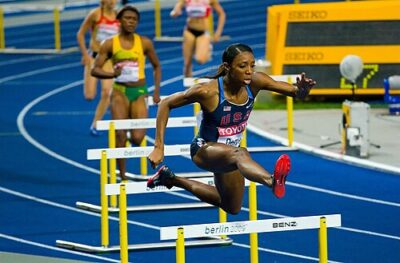
Lashinda Demus
Lashinda Demus is an American female Olympic 400m hurdler. Born March 10, 1983, in Inglewood. Educated at University of South Carolina and Woodrow Wilson Classical High School.
Facts
8 facts · 1 confirmed by two sources · 1 cited · 6 from one source
Where this comes from
Papalocal keeps its own record. It started from these sources; what each one said is kept here as it was copied, so a change on their side never changes this page by itself. Tap one to read its version.
What Wikidata says · copied November 15, 2026 · revision 2568846349
- Described as
- American female Olympic 400m hurdler
- Other names
- Lashinda Monique Demus
- Born
- March 10, 1983 · 1 reference
- Born in
- Inglewood
- Citizen of
- United States
- Occupation
- hurdler
- Education
- University of South Carolina · 1 reference; Woodrow Wilson Classical High School · 2 references
- Sport
- athletics
- Height
- 1.70 m (5 ft 7 in)
- Wikipedias with a page
- 27
Wikidata item Q6086 (wikidata.org/wiki/Q6086), public domain (CC0). Copied November 15, 2026.
What Wikipedia says · copied November 15, 2026 · revision 1364564925
Lashinda Demus (born March 10, 1983) is an American retired hurdler who specialized in the 400 meter hurdles, an event in which she was the 2011 world champion and 2012 Olympic gold medalist, becoming the first woman from the United States to win the Olympic 400 m hurdles title.
Demus' personal best time over 400 m hurdles is 52.47 seconds, set in Daegu, South Korea on September 1, 2011, making her as of December 2022 the seventh-fastest woman in history in the event. At the time it was the American record. She is a five-time national champion (400 m hurdles), and a four-time NCAA champion (400 m hurdles, 400 m indoors and 4 × 400 m relay out and indoors).
- Born, in its opening lines
- March 10, 1983
From the Wikipedia article “Lashinda Demus” (en.wikipedia.org/wiki/Lashinda_Demus), by its contributors, under CC BY-SA 4.0 (creativecommons.org/licenses/by-sa/4.0/). Copied November 15, 2026; not changed.
Confirmed Two sources agree. Cited One source, and it names where it got it. One source One source, without a reference of its own. Sources disagree The sources disagree. We show the best-supported value and keep theirs below.
