
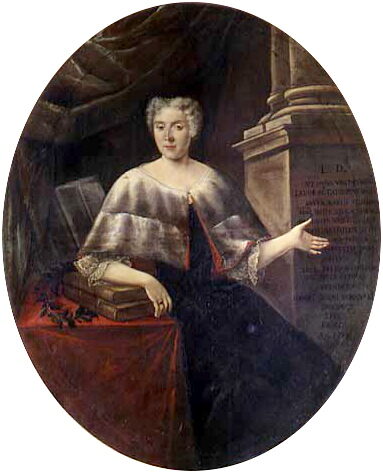
Laura Bassi
Laura Bassi was an Italian physicist. Born October 29, 1711, in Bologna. Died February 20, 1778, in Bologna. Known for On air compression. Educated at University of Bologna.
Facts
26 facts · 2 confirmed by two sources · 14 cited · 10 from one source
Where this comes from
Papalocal keeps its own record. It started from these sources; what each one said is kept here as it was copied, so a change on their side never changes this page by itself. Tap one to read its version.
What Wikidata says · copied November 16, 2026 · revision 2568150142
- Described as
- Italian physicist (1711-1778)
- Other names
- Laura Bassi Veratti, Laura Maria Caterina Bassi Veratti, Laura Maria Caterina Bassi
- Born
- October 29, 1711 · 3 references
- Died
- February 20, 1778 · 6 references
- Born in
- Bologna · 1 reference
- Died in
- Bologna · 1 reference
- Buried in
- Santuario del Corpus Domini
- Name at birth
- Laura Maria Caterina Bassi · 1 reference
- Citizen of
- Papal States
- Occupation
- physicist · 1 reference; university teacher; mathematician; anatomist; professor of philosophy (1732–); philosopher · 2 references; biologist · 1 reference
- Worked for
- University of Bologna (1732–) · 1 reference
- Education
- University of Bologna · 1 reference
- Member of
- Academy of Sciences of the Institute of Bologna (1732–) · 1 reference; Arcadian Academy
- Known for
- On air compression
- Field
- physics · 1 reference; biology · 1 reference; anatomy · 1 reference
- Spouse
- Giovanni Giuseppe Veratti (1738–) · 1 reference
- Father
- Giuseppe Bassi · 1 reference
- Mother
- Rosa Cesarei
- Lived in
- Italy · 1 reference
- Wikipedias with a page
- 58
Wikidata item Q541652 (wikidata.org/wiki/Q541652), public domain (CC0). Copied November 16, 2026.
What Wikipedia says · copied November 16, 2026 · revision 1385566978
Laura Maria Caterina Bassi Veratti (29 October 1711 – 20 February 1778) was an Italian physicist and academic. Recognized and depicted as "Minerva" (goddess of wisdom), she was the first woman to have a doctorate in science, and the second woman in the world to earn the Doctor of Philosophy degree. Working at the University of Bologna, she was the first salaried female teacher in a university. At one time the highest paid employee of the university, by the end of her life Bassi held two other professorships. She was also the first female member of any scientific establishment, when she was elected to the Academy of Sciences of the Institute of Bologna in 1732 at 21.
Bassi did not receive formal education; instead, she was privately tutored from the age of five until she was twenty. By then, she was well-versed in major disciplines, including sciences and mathematics. Noticing her ability, Prospero Lambertini, the Archbishop of Bologna (later Pope Benedict XIV), became her patron. With Lambertini's arrangement, she publicly defended forty-nine theses before professors of the University of Bologna on 17 April 1732, for which she was awarded a doctoral degree on 12 May. A month later, she was appointed by the university as its first female teacher, albeit with the restriction that she was not allowed to teach all-male classes. Lambertini, by then the Pope, helped her to receive permissions for private classes and experiments, which were granted by the university in 1740.
Bassi became the most important populariser of Newtonian mechanics in Italy. She was inducted by the Pope to the Benedettini (similar to modern Pontifical Academy of Sciences) as an additional member in 1745. She took up the Chair of Experimental Physics in 1776, the position she held until her death. She is interred at the Church of Corpus Domini, Bologna.
- Born, in its opening lines
- October 29, 1711
- Died, in its opening lines
- February 20, 1778
From the Wikipedia article “Laura Bassi” (en.wikipedia.org/wiki/Laura_Bassi), by its contributors, under CC BY-SA 4.0 (creativecommons.org/licenses/by-sa/4.0/). Copied November 16, 2026; not changed.
Confirmed Two sources agree. Cited One source, and it names where it got it. One source One source, without a reference of its own. Sources disagree The sources disagree. We show the best-supported value and keep theirs below.
