
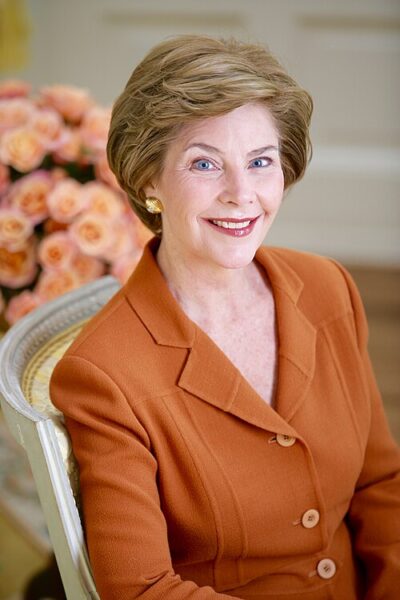
Laura Bush
Laura Bush is a First Lady of the United States from 2001 to 2009. Born November 4, 1946, in Midland. Positions held include First Lady of the United States (2001–2009). Educated at Southern Methodist University and University of Texas at Austin. Awards include The Nichols-Chancellor's Medal and Library of Congress Living Legend.
Facts
26 facts · 1 confirmed by two sources · 6 cited · 19 from one source
Where this comes from
Papalocal keeps its own record. It started from these sources; what each one said is kept here as it was copied, so a change on their side never changes this page by itself. Tap one to read its version.
What Wikipedia says · copied November 13, 2026 · revision 1384338979
Laura Lane Welch Bush (née Welch; born November 4, 1946) is an American educator who was the first lady of the United States from 2001 to 2009 as the wife of George W. Bush, the 43rd president of the United States. Bush was also the first lady of Texas from 1995 to 2000 when her husband was governor.
Born in Midland, Texas, Bush graduated from Southern Methodist University in 1968 with a bachelor's degree in education, and took a job as a second grade teacher. After attaining her master's degree in library science at the University of Texas at Austin, she was employed as a librarian. Bush met her future husband, George W. Bush, in 1977, and they were married later that year. The couple had twin daughters, Barbara and Jenna in 1981. Bush's political involvement began during her marriage. She campaigned with her husband during his unsuccessful 1978 run for the United States Congress, and later for his successful Texas gubernatorial campaign.
As First Lady of Texas, Bush implemented many initiatives focused on health, education, and literacy. From 1999 to 2000, she aided her husband in campaigning for the presidency in several ways, such as delivering a prominent address at the 2000 Republican National Convention, which gained her national attention. She became first lady after her husband was inaugurated as president on January 20, 2001.
Polled by the Gallup Organization as one of the most popular first ladies, Bush was involved in national and global concerns during her tenure. She continued to advance her trademark interests of education and literacy by establishing the annual National Book Festival in 2001. She encouraged education on a worldwide scale. She also advanced women's causes through the Heart Truth and Susan G. Komen for the Cure organizations. She represented the United States during her foreign trips, which tended to focus on HIV/AIDS and malaria awareness.
- Born, in its opening lines
- November 4, 1946
From the Wikipedia article “Laura Bush” (en.wikipedia.org/wiki/Laura_Bush), by its contributors, under CC BY-SA 4.0 (creativecommons.org/licenses/by-sa/4.0/). Copied November 13, 2026; not changed.
What Wikidata says · copied November 14, 2026 · revision 2569089817
- Described as
- First Lady of the United States from 2001 to 2009
- Other names
- Laura Lane Welch, Laura Welch, Laura Welch Bush, Laura Lane Welch Bush
- Born
- November 4, 1946 · 7 references
- Born in
- Midland
- Name at birth
- Laura Lane Welch
- Citizen of
- United States · 1 reference
- Occupation
- librarian · 1 reference; teacher · 1 reference; autobiographer; children's writer; writer; politician; HIV/AIDS activist; president · 1 reference
- Positions held
- First Lady of the United States (2001–2009)
- Political party
- Republican Party
- Education
- Southern Methodist University; University of Texas at Austin; Robert E. Lee High School · 1 reference
- Member of
- Daughters of the American Revolution
- Awards
- The Nichols-Chancellor's Medal; Library of Congress Living Legend (2008–) · 1 reference
- Spouse
- George W. Bush (1977–) · 1 reference
- Children
- Barbara Bush; Jenna Bush Hager · 1 reference
- Father
- Harold Welch
- Mother
- Jenna Welch
- Religion
- United Methodist Church
- Wikipedias with a page
- 95
Wikidata item Q152019 (wikidata.org/wiki/Q152019), public domain (CC0). Copied November 14, 2026.
Confirmed Two sources agree. Cited One source, and it names where it got it. One source One source, without a reference of its own. Sources disagree The sources disagree. We show the best-supported value and keep theirs below.
