
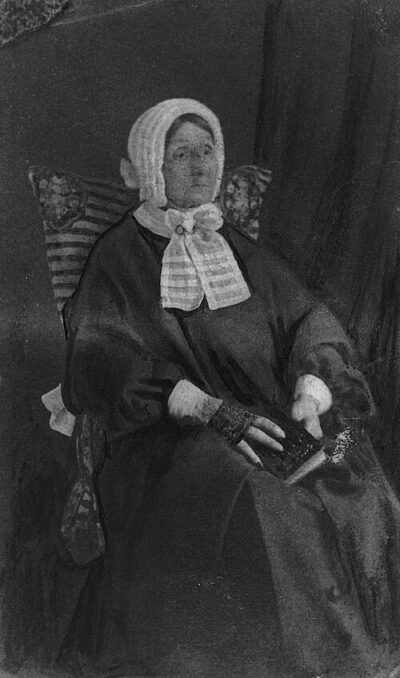
Laura Secord
Laura Secord was a Canadian heroine of the War of 1812. Born September 13, 1775, in Great Barrington. Died October 17, 1868, in Chippawa. Awards include Person of National Historic Significance.
Facts
11 facts · 2 confirmed by two sources · 7 cited · 2 from one source
Where this comes from
Papalocal keeps its own record. It started from these sources; what each one said is kept here as it was copied, so a change on their side never changes this page by itself. Tap one to read its version.
What Wikidata says · copied November 16, 2026 · revision 2532199547
- Described as
- Canadian heroine of the War of 1812 (1775–1868)
- Other names
- Laura Ingersoll
- Born
- September 13, 1775 · 6 references
- Died
- October 17, 1868 · 5 references
- Born in
- Great Barrington · 1 reference
- Died in
- Chippawa
- Buried in
- Drummond Hill Cemetery · 1 reference
- Name at birth
- Laura Ingersoll · 1 reference
- Citizen of
- Canada
- Awards
- Person of National Historic Significance · 1 reference
- Spouse
- James Secord · 1 reference
- Father
- Thomas Ingersoll · 1 reference
- Mother
- Elizabeth Lydia Ingersol · 1 reference
- Wikipedias with a page
- 21
Wikidata item Q434840 (wikidata.org/wiki/Q434840), public domain (CC0). Copied November 16, 2026.
What Wikipedia says · copied November 16, 2026 · revision 1384954560
Laura Secord (née Ingersoll; 13 September 1775 – 17 October 1868) was a Canadian woman involved in the War of 1812. She is known for having walked 20 miles (32 km) out of American-occupied territory in 1813 to warn British forces of an impending American attack. Her contribution to the war was little known during her lifetime, but since her death she has been frequently honoured in Canada. Though Laura Secord had no relation to it, most Canadians associate her with the Laura Secord Chocolates company, named after her on the centennial of her walk.
Laura Secord's father, Thomas Ingersoll, lived in Massachusetts and fought on the side of the Patriots during the Revolutionary War (1775–1783). In 1795 he moved his family to the Niagara region of Upper Canada after he had applied for and received a land grant. Shortly after, Laura married Loyalist James Secord, who was later seriously wounded at the Battle of Queenston Heights early in the War of 1812. While he was still recovering in 1813, the Americans invaded the Niagara Peninsula, including Queenston. During the occupation, Secord acquired information about a planned American attack, and stole away on the morning of 22 June to inform Lieutenant James FitzGibbon in the territory still controlled by the British. The information helped the British and their Mohawk allies repel the invading Americans at the Battle of Beaver Dams. Her effort was forgotten until 1860, when Edward, Prince of Wales, awarded the impoverished widow £100 (£13,000 in 2022) for her service on his visit to Canada.
The story of Laura Secord has taken on mythic overtones in Canada. Her tale has been the subject of books, plays, and poetry, often with many embellishments. Since her death, Canada has bestowed honours on her, including schools named after her, monuments, a museum, a memorial stamp and coin, and a statue at the Valiants Memorial in the Canadian capital.
- Born, in its opening lines
- September 13, 1775
- Died, in its opening lines
- October 17, 1868
From the Wikipedia article “Laura Secord” (en.wikipedia.org/wiki/Laura_Secord), by its contributors, under CC BY-SA 4.0 (creativecommons.org/licenses/by-sa/4.0/). Copied November 16, 2026; not changed.
Confirmed Two sources agree. Cited One source, and it names where it got it. One source One source, without a reference of its own. Sources disagree The sources disagree. We show the best-supported value and keep theirs below.
