
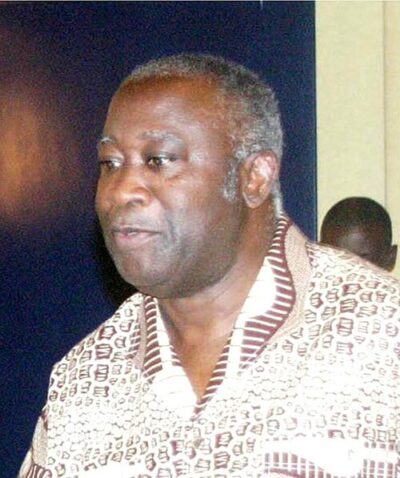
Laurent Gbagbo
Laurent Gbagbo is the 4th President of Ivory Coast. Born May 31, 1945, in Gagnoa. Positions held include President of the Ivory Coast (2000–2011) and Member of the National Assembly of Cote d'Ivoire. Educated at Paris Diderot University and University of Lyon. Awards include National Order of the Ivory Coast.
Facts
19 facts · 1 confirmed by two sources · 7 cited · 11 from one source
Where this comes from
Papalocal keeps its own record. It started from these sources; what each one said is kept here as it was copied, so a change on their side never changes this page by itself. Tap one to read its version.
What Wikidata says · copied November 16, 2026 · revision 2567141906
- Described as
- 4th President of Ivory Coast
- Other names
- Laurent Koudou Gbagbo, Koudou Laurent Gbagbo, Gbagbo, woody de Mama
- Born
- May 31, 1945 · 4 references
- Born in
- Gagnoa
- Citizen of
- Ivory Coast
- Occupation
- politician · 1 reference; writer · 1 reference; university teacher
- Positions held
- President of the Ivory Coast (2000–2011); Member of the National Assembly of Cote d'Ivoire · 2 references
- Political party
- RHDP; Parti des peuples africains-Côte d'Ivoire (2021–) · 2 references
- Education
- Paris Diderot University; University of Lyon; Paris Cité University
- Awards
- National Order of the Ivory Coast
- Spouse
- Simone Gbagbo (1989–2023) · 1 reference; Nady Bamba (2024–) · 1 reference
- Children
- Michel Gbagbo · 1 reference
- Religion
- Catholicism
- Lived in
- Ivory Coast (2000–) · 1 reference
- Wikipedias with a page
- 73
Wikidata item Q179242 (wikidata.org/wiki/Q179242), public domain (CC0). Copied November 16, 2026.
What Wikipedia says · copied November 16, 2026 · revision 1381465859
Koudou Laurent Gbagbo (born 31 May 1945) is an Ivorian politician who served as the president of Côte d'Ivoire from 2000 until his arrest in April 2011. He was the first president in the history of the country that was a centre-left politician. A historian, Gbagbo was imprisoned in the early 1970s and again in the early 1990s, and he lived in exile in France during much of the 1980s as a result of his union activism. Gbagbo founded the Ivorian Popular Front (FPI) in 1982 and ran unsuccessfully for president against Félix Houphouët-Boigny at the start of multi-party politics in 1990. He won a seat in the National Assembly of Côte d'Ivoire in 1990.
Gbagbo claimed victory after Robert Guéï, head of a military junta, barred other leading politicians from running in the October 2000 presidential election. The Ivorian people took to the streets, toppling Guéï. Gbagbo was then installed as president.
In the 2010 presidential election, Alassane Ouattara defeated Gbagbo, and was recognized as the winner by election observers, the international community, the African Union (AU), and the Economic Community of West African States. However, Gbagbo refused to step down, despite mounting international pressure. The Independent Electoral Commission (IEC) announced that Ouattara had won the race with 54% of the vote, a tally that the United Nations concluded was credible; however, the Constitutional Council, a body dominated by pro-Gbagbo members, annulled the results in Ouattara's electoral strongholds in the north, claiming fraud, and declared Gbagbo the winner with 51% of the vote. In December 2010, both Gbagbo and Ouattara assumed the presidency, triggering a short period of civil conflict in which about 3,000 people were killed.
Gbagbo was arrested in 2011 by pro-Ouattara forces, who were supported by French troops. Gbagbo was extradited to The Hague in November 2011, where he was charged with four counts of crimes against humanity in the International Criminal Court (ICC) in connection with the post-election violence. Gbagbo was the first former head of state to be taken into the court's custody. In January 2019, an ICC panel dismissed the charges against Gbagbo and one of his former ministers, Charles Blé Goudé, determining that the evidence presented was insufficient to prove that the pair committed crimes against humanity. Prosecutors appealed the decision, and Gbagbo was prohibited from returning to Côte d'Ivoire pending the appeal proceedings. The ICC ultimately upheld Gbagbo's acquittal, and in April 2021, Ouattara stated he and Blé Goudé were free to return to the country.
- Born, in its opening lines
- May 31, 1945
From the Wikipedia article “Laurent Gbagbo” (en.wikipedia.org/wiki/Laurent_Gbagbo), by its contributors, under CC BY-SA 4.0 (creativecommons.org/licenses/by-sa/4.0/). Copied November 16, 2026; not changed.
Confirmed Two sources agree. Cited One source, and it names where it got it. One source One source, without a reference of its own. Sources disagree The sources disagree. We show the best-supported value and keep theirs below.
