
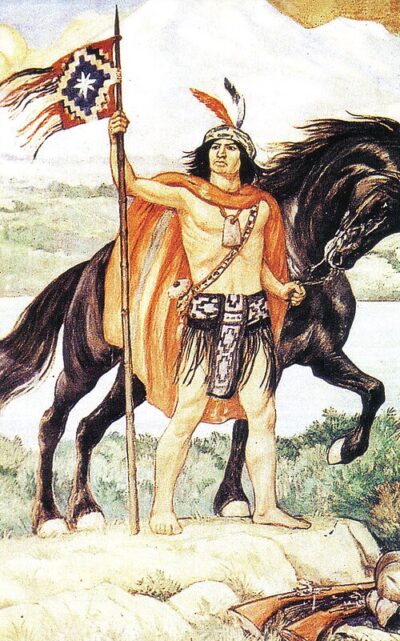
Lautaro was a leader of Mapuche people. Born 1535, in Tirúa. Died April 29, 1557, in Hualañé.
Facts
7 facts · 1 confirmed by two sources · 0 cited · 5 from one source · 1 where the sources disagree
What’s different
- Born: we show 1535 (Sources disagree). Wikipedia says c. 1534
Where this comes from
Papalocal keeps its own record. It started from these sources; what each one said is kept here as it was copied, so a change on their side never changes this page by itself. Tap one to read its version.
What Wikidata says · copied November 17, 2026 · revision 2564641314
- Described as
- leader of Mapuche people
- Other names
- Leftraru, Lef-Traru, El toqui Lautaro
- Born
- 1535 · 1 reference
- Died
- April 29, 1557
- Born in
- Tirúa · 1 reference
- Died in
- Hualañé
- Occupation
- warrior
- Spouse
- Guacolda
- Military rank
- toqui
- Wikipedias with a page
- 26
Wikidata item Q453156 (wikidata.org/wiki/Q453156), public domain (CC0). Copied November 17, 2026.
What Wikipedia says · copied November 17, 2026 · revision 1379813080
Lautaro (Anglicized as 'Levtaru') (Mapudungun: Lef-Traru "swift hawk") (Spanish pronunciation: [lawˈtaɾo]; c. 1534 – April 29, 1557) was a young Mapuche toqui known for leading the indigenous resistance against Spanish conquest in Chile and developing the tactics that would continue to be employed by the Mapuche during the long-running Arauco War. He is revered among Mapuche and non-Mapuche Chileans and Argentinians for his resistance against foreign conquest, servitude and cruelty.
Captured by Spanish forces in his early youth, Lautaro spent his teenage years as a personal servant of chief conquistador Pedro de Valdivia. He graduated from servant to stableman; in this job he saw that their horses were not godlike creatures like his people thought (the biggest animal they knew was the llama). He escaped in 1551 and told his people that the conquistadores and their horses were just mortals and they could defeat them. Back among his people he was declared Toqui and led Mapuche warriors into a series of victories against the Spaniards, culminating in the Battle of Tucapel in December 1553, where Valdivia was killed. The outbreak of a typhus plague, a drought and a famine prevented the Mapuche from taking further actions to expel the Spaniards in 1554 and 1555. Between 1556 and 1557, a small group of Mapuche commanded by Lautaro attempted to reach Santiago to liberate the whole of Central Chile from Spanish rule. Lautaro's attempts ended in 1557 when he was killed in an ambush by the Spaniards.
- Born, in its opening lines
- c. 1534
- Died, in its opening lines
- April 29, 1557
From the Wikipedia article “Lautaro” (en.wikipedia.org/wiki/Lautaro), by its contributors, under CC BY-SA 4.0 (creativecommons.org/licenses/by-sa/4.0/). Copied November 17, 2026; not changed.
Confirmed Two sources agree. Cited One source, and it names where it got it. One source One source, without a reference of its own. Sources disagree The sources disagree. We show the best-supported value and keep theirs below.
