
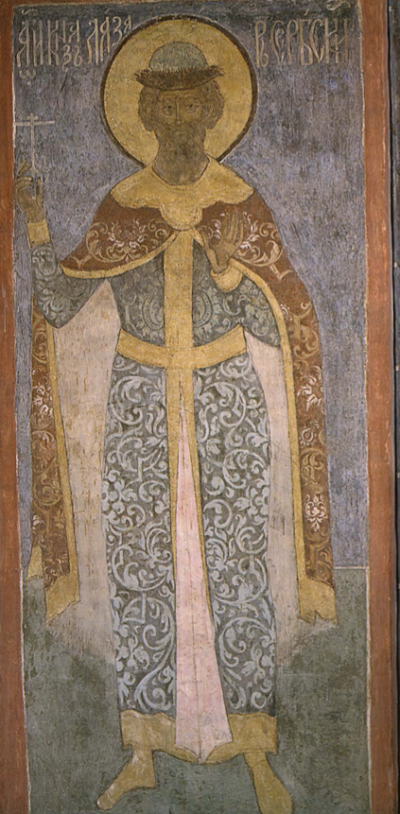
Lazar Hrebeljanović
Lazar Hrebeljanović was a Medieval Serbian ruler. Born 1329, in Prilepac. Died June 15, 1389, in Kosovo Field. Positions held include tsar.
Facts
21 facts · 2 confirmed by two sources · 4 cited · 14 from one source · 1 where the sources disagree
What’s different
- Buried in: we show Ravanica (1391–) (Sources disagree). Wikidata also lists Church of the Ascension in Priština and Belgrade
Where this comes from
Papalocal keeps its own record. It started from these sources; what each one said is kept here as it was copied, so a change on their side never changes this page by itself. Tap one to read its version.
What Wikidata says · copied November 16, 2026 · revision 2565559687
- Described as
- Medieval Serbian ruler
- Other names
- Lazar Hrebeljanovic, Prince of Serbia, Lazar of Serbia
- Born
- 1329 · 7 references
- Died
- June 15, 1389 · 1 reference
- Born in
- Prilepac
- Died in
- Kosovo Field
- Buried in
- Ravanica (1391–); Church of the Ascension in Priština (1389–1391); Belgrade
- Citizen of
- Moravian Serbia (1371–1389); Kingdom of Serbia (1329–1346); Serbian Empire (1346–1371)
- Occupation
- politician
- Positions held
- tsar
- Spouse
- Milica Hrebeljanović
- Children
- Mara Lazarevic Brankovic · 1 reference; Olivera Lazarević · 1 reference; Jelena Balšić; Stefan Lazarević · 1 reference; Teodora Lazarević; Dragana of Serbia; Vuk Lazarević
- Father
- Pribac Hrebeljanović
- Mother
- NN · 1 reference
- Religion
- Serbian Orthodox Church
- Wikipedias with a page
- 41
Wikidata item Q310197 (wikidata.org/wiki/Q310197), public domain (CC0). Copied November 16, 2026.
What Wikipedia says · copied November 16, 2026 · revision 1369112532
Lazar Hrebeljanović (Serbian Cyrillic: Лазар Хребељановић; c. 1329 – 15 June 1389) was a medieval Serbian ruler who created the largest and most powerful state on the territory of the disintegrated Serbian Empire. Lazar's state, referred to by historians as Moravian Serbia, comprised the basins of the Great Morava, West Morava, and South Morava rivers. Lazar ruled Moravian Serbia from 1371 until his death in 1389. He sought to resurrect the Serbian Empire and place himself at its helm, claiming to be the direct successor of the Nemanjić dynasty, which went extinct in 1371 after ruling over Serbia for two centuries. Lazar's programme had the full support of the Serbian Orthodox Church, but the Serbian nobility did not recognize him as their supreme ruler. He is often referred to as Tsar Lazar Hrebeljanović (Serbian: Цар Лазар Хребељановић / Car Lazar Hrebeljanović); however, he only held the title of prince (Serbian: кнез / knez).
Lazar was killed at the Battle of Kosovo in June 1389 while leading a Christian army assembled to confront the invading Ottoman Empire, led by Sultan Murad I. The battle ended without a clear victor, with both sides enduring heavy losses. In order to protect the weakened Serbian state from the Hungarian invasion from the north, Lazar's widow, Milica, who ruled as regent for their adolescent son Stefan Lazarević, Lazar's successor, accepted Ottoman suzerainty in the summer of 1390 in exchange for a military alliance.
Lazar is venerated in the Orthodox Christian Church as a martyr and saint, and is highly regarded in Serbian history, culture and tradition. In Serbian epic poetry, he is referred to as Tsar Lazar (Serbian: Цар Лазар / Car Lazar).
- Born, in its opening lines
- c. 1329
- Died, in its opening lines
- June 15, 1389
From the Wikipedia article “Lazar of Serbia” (en.wikipedia.org/wiki/Lazar_of_Serbia), by its contributors, under CC BY-SA 4.0 (creativecommons.org/licenses/by-sa/4.0/). Copied November 16, 2026; not changed.
Confirmed Two sources agree. Cited One source, and it names where it got it. One source One source, without a reference of its own. Sources disagree The sources disagree. We show the best-supported value and keep theirs below.
