
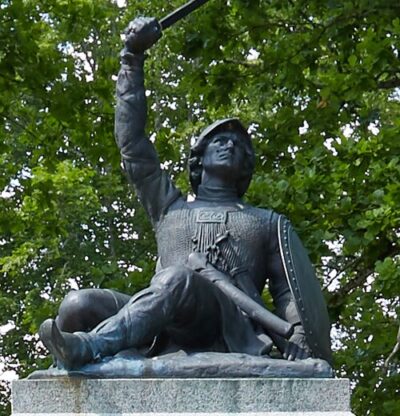
Lembitu was an Estonian noble (died 1217). Born 12th century. Died September 21, 1217, in Viljandi.
Facts
4 facts · 1 confirmed by two sources · 0 cited · 3 from one source
Where this comes from
Papalocal keeps its own record. It started from these sources; what each one said is kept here as it was copied, so a change on their side never changes this page by itself. Tap one to read its version.
What Wikidata says · copied November 18, 2026 · revision 2537879091
- Described as
- Estonian noble (died 1217)
- Born
- 12th century
- Died
- September 21, 1217
- Died in
- Viljandi
- Occupation
- military personnel
- Wikipedias with a page
- 23
Wikidata item Q960492 (wikidata.org/wiki/Q960492), public domain (CC0). Copied November 18, 2026.
What Wikipedia says · copied November 18, 2026 · revision 1373770732
Lembitu (Estonian also: Lembit, died 21 September 1217) was an ancient Estonian senior (elder) from Sakala County and military leader in the struggle against conquest of the Estonian lands by the German Livonian Brothers of the Sword at the beginning of the 13th century. He is the only Estonian pre-Crusade ruler, about whom some biographical information is known (he is mentioned only in the Livonian Chronicle of Henry).
Lembitu, also referred to in Latin as Lambite, Lembito or Lembitus, was first mentioned in chronicles in 1211. Troops led by Lembitu destroyed a troop of missionaries in the historical Estonian county of Sakala (Sackalia) and made a raid as far as Pskov, then a town of the Novgorod Republic. In 1215, Lembitu's Lehola (Leal) stronghold (situated near the present town of Suure-Jaani) was taken by Germans and Lembitu was taken prisoner. He was released in 1217.
Lembitu attempted to unite the Estonians in order to withstand the German conquest. He managed to assemble an army of 6,000 Estonian men from different counties, but was killed in the following Battle of St. Matthew's Day in September 1217.
- Died, in its opening lines
- September 21, 1217
From the Wikipedia article “Lembitu” (en.wikipedia.org/wiki/Lembitu), by its contributors, under CC BY-SA 4.0 (creativecommons.org/licenses/by-sa/4.0/). Copied November 18, 2026; not changed.
Confirmed Two sources agree. Cited One source, and it names where it got it. One source One source, without a reference of its own. Sources disagree The sources disagree. We show the best-supported value and keep theirs below.
