
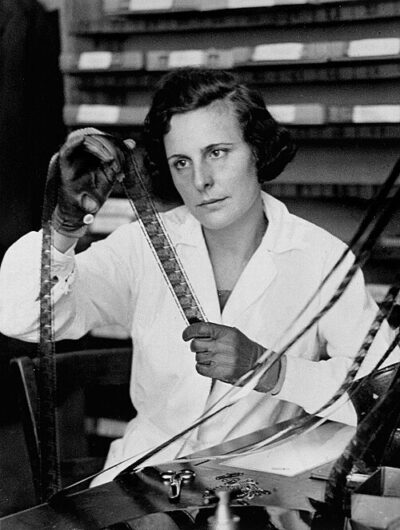
Leni Riefenstahl
Leni Riefenstahl was a German filmmaker, photographer, actress, and nazi propagandist. Born August 22, 1902, in Berlin. Died September 8, 2003, in Pöcking. Known for Olympia Part One: Festival of the Nations and Olympia Part Two: Festival of Beauty. Awards include Mussolini Cup and German Olympic Decoration 2nd Class.
Facts
29 facts · 2 confirmed by two sources · 16 cited · 11 from one source
Where this comes from
Papalocal keeps its own record. It started from these sources; what each one said is kept here as it was copied, so a change on their side never changes this page by itself. Tap one to read its version.
What Wikidata says · copied November 16, 2026 · revision 2565534674
- Described as
- German filmmaker, photographer, actress, and nazi propagandist (1902–2003)
- Other names
- Helene Bertha Amalie Riefenstahl, Leni Riefensthal, Berra Helene Amalia Riefenstahl, Lenie Riefenstahl, Leni Jacob, Riefenstahl, Leni, 1902-2003
- Born
- August 22, 1902 · 16 references
- Died
- September 8, 2003 · 9 references
- Born in
- Berlin · 2 references
- Died in
- Pöcking · 1 reference
- Buried in
- Munich Waldfriedhof · 1 reference
- Name at birth
- Helene Bertha Amalia Riefenstahl
- Citizen of
- Germany · 1 reference; Sudan · 1 reference; German Empire · 1 reference; Weimar Republic · 1 reference
- Occupation
- film producer · 1 reference; film editor; screenwriter · 1 reference; film actor; film director · 1 reference; actor · 2 references; photographer · 5 references; director · 3 references
- Known for
- Olympia Part One: Festival of the Nations · 1 reference; Olympia Part Two: Festival of Beauty · 1 reference
- Awards
- Mussolini Cup (1938) · 1 reference; German Olympic Decoration 2nd Class · 1 reference
- Field
- performing arts
- Spouse
- Horst Kettner (2003) · 2 references; Peter Jacob (1944–1946) · 2 references
- Siblings
- Heinz Riefenstahl · 1 reference
- Religion
- Lutheranism
- Lived in
- Pöcking (1979–2003) · 1 reference
- Website
- http://leni-riefenstahl.de
- Wikipedias with a page
- 94
Wikidata item Q55415 (wikidata.org/wiki/Q55415), public domain (CC0). Copied November 16, 2026.
What Wikipedia says · copied November 16, 2026 · revision 1385286718
Helene Bertha Amalie "Leni" Riefenstahl (German: [ˈleːniː ˈʁiːfn̩ʃtaːl] ; 22 August 1902 – 8 September 2003) was a German filmmaker, photographer, and actress. She is considered one of the most controversial personalities in film history. Regarded by many critics as an "innovative filmmaker and creative aesthete", she is also criticized for her works in the service of propaganda during the Nazi era.
A talented swimmer and an artist, Riefenstahl became interested in dancing during her childhood, taking lessons and performing across all Europe. After seeing a promotional poster for the 1924 film Mountain of Destiny, she was inspired to move into acting and between 1925 and 1929 starred in five successful motion pictures. Riefenstahl became one of the few women in Germany to direct a film during the Weimar era when, in 1932, she decided to try directing with her own film, The Blue Light.
In the 1930s, she directed the Nazi propaganda films Triumph of the Will (1935) and Olympia (1938), resulting in worldwide attention and acclaim. The films are widely considered two of the most effective and technically innovative propaganda films ever made. Her involvement in Triumph of the Will, however, significantly damaged her career and reputation after World War II. Adolf Hitler closely collaborated with Riefenstahl during the production of at least three important Nazi films, and they formed a friendly relationship.
After the war, Riefenstahl was arrested and found to be a Nazi "fellow traveller" but was not charged with war crimes. Throughout her later life, she denied having known about the Holocaust, and was criticized as the "voice of the 'how could we have known?' defence". Riefenstahl's post-war work includes the release of the film Tiefland in 1954, her work as a photographer, her autobiography in 1987, underwater photographs and two photo books on the Nuba peoples of southern Sudan.
- Born, in its opening lines
- August 22, 1902
- Died, in its opening lines
- September 8, 2003
From the Wikipedia article “Leni Riefenstahl” (en.wikipedia.org/wiki/Leni_Riefenstahl), by its contributors, under CC BY-SA 4.0 (creativecommons.org/licenses/by-sa/4.0/). Copied November 16, 2026; not changed.
Confirmed Two sources agree. Cited One source, and it names where it got it. One source One source, without a reference of its own. Sources disagree The sources disagree. We show the best-supported value and keep theirs below.
