
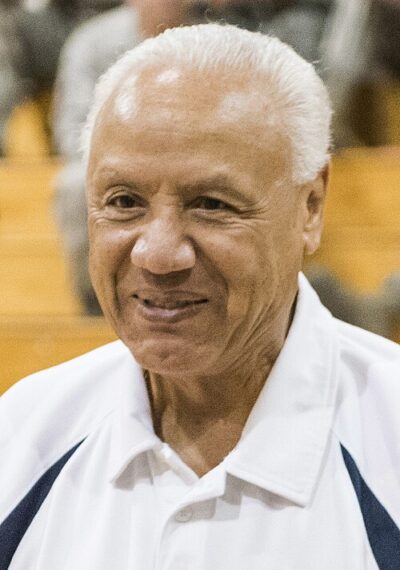
Lenny Wilkens
Lenny Wilkens was an American basketball player and coach. Born October 28, 1937, in Brooklyn. Died November 9, 2025, in Medina. Teams include Portland Trail Blazers (1974–1975), Atlanta Hawks (1960–1968) and Cleveland Cavaliers (1972–1974). Educated at Providence College and Boys and Girls High School. Awards include NBA All-Star Game Kobe Bryant Most Valuable Player Award, NBA Coach of the Year Award and Chuck Daly Lifetime Achievement Award.
Facts
23 facts · 2 confirmed by two sources · 8 cited · 13 from one source
Where this comes from
Papalocal keeps its own record. It started from these sources; what each one said is kept here as it was copied, so a change on their side never changes this page by itself. Tap one to read its version.
What Wikidata says · copied November 14, 2026 · revision 2529340256
- Described as
- American basketball player and coach (1937–2025)
- Other names
- Leonard Randolph "Lenny" Wilkens, Leonard Randolph Wilkens, Leonard "Lenny" Wilkens
- Born
- October 28, 1937 · 5 references
- Died
- November 9, 2025 · 1 reference
- Born in
- Brooklyn · 2 references
- Died in
- Medina
- Name at birth
- Leonard Randolph Wilkens
- Citizen of
- United States · 2 references
- Occupation
- basketball player · 1 reference; basketball coach · 1 reference
- Education
- Providence College · 1 reference; Boys and Girls High School · 1 reference; Boys High School · 1 reference
- Member of
- Alpha Phi Alpha
- Teams
- Portland Trail Blazers (1974–1975); Atlanta Hawks (1960–1968); Cleveland Cavaliers (1972–1974); Seattle SuperSonics (1968–1972); Providence Friars men's basketball (1957–1960) · 1 reference
- Sport
- basketball · 1 reference
- Awards
- NBA All-Star Game Kobe Bryant Most Valuable Player Award (1971); NBA Coach of the Year Award (1994); Chuck Daly Lifetime Achievement Award (2011)
- Religion
- Catholicism
- Height
- 1.85 m (6 ft 1 in) · 1 reference
- Wikipedias with a page
- 40
Wikidata item Q316161 (wikidata.org/wiki/Q316161), public domain (CC0). Copied November 14, 2026.
What Wikipedia says · copied November 14, 2026 · revision 1382540808
Leonard Randolph Wilkens (October 28, 1937 – November 9, 2025) was an American professional basketball player and coach in the National Basketball Association (NBA). He has been inducted three times into the Naismith Memorial Basketball Hall of Fame, first in 1989 as a player, as a coach in 1998, and in 2010 as part of the 1992 United States Olympic "Dream Team" for which he was an assistant coach. In 1996, Wilkens was named to the NBA 50th Anniversary Team, and in 2021 he was named to the NBA 75th Anniversary Team. In addition, in 2022 he was also named to the list of the 15 Greatest Coaches in NBA History, being the only person to be in both NBA 75th anniversary lists as a player and as a coach. He is also a 2006 inductee into the College Basketball Hall of Fame.
Wilkens made a combined 13 NBA All-Star Game appearances as a player (nine times) and as a head coach (four times), was the 1994 NBA Coach of the Year, won the 1979 NBA championship as the head coach of the Seattle SuperSonics, and was the head coach of the Olympic gold medal–winning 1996 U.S. men's basketball team.
During the 1994–95 season, Wilkens set the record for most regular season coaching wins in NBA history, a record he held when he retired with 1,332 victories. As of February 2022, he is in third place on the list, behind Don Nelson and Gregg Popovich. Wilkens won the Chuck Daly Lifetime Achievement Award for the 2010–11 NBA season. Wilkens is also the most prolific coach in NBA history, at 2,487 regular-season games, 89 more games than Nelson, and over 400 more than any other coach, and has more losses than any other coach in NBA history, at 1,155.
- Born, in its opening lines
- October 28, 1937
- Died, in its opening lines
- November 9, 2025
From the Wikipedia article “Lenny Wilkens” (en.wikipedia.org/wiki/Lenny_Wilkens), by its contributors, under CC BY-SA 4.0 (creativecommons.org/licenses/by-sa/4.0/). Copied November 14, 2026; not changed.
Confirmed Two sources agree. Cited One source, and it names where it got it. One source One source, without a reference of its own. Sources disagree The sources disagree. We show the best-supported value and keep theirs below.
