
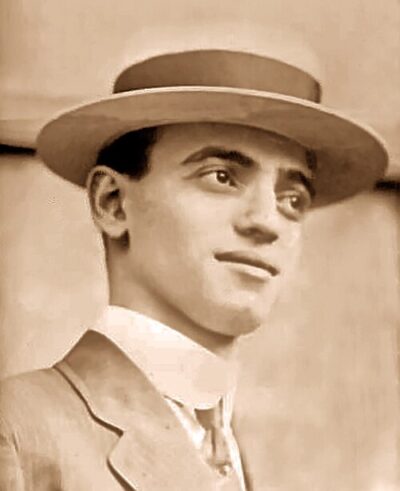
Leo Frank
Leo Frank was an American factory superintendent and lynching victim. Born April 17, 1884, in Cuero. Died August 17, 1915, in Marietta. Educated at Cornell University and Cornell University College of Engineering.
Facts
15 facts · 2 confirmed by two sources · 5 cited · 8 from one source
Where this comes from
Papalocal keeps its own record. It started from these sources; what each one said is kept here as it was copied, so a change on their side never changes this page by itself. Tap one to read its version.
What Wikidata says · copied November 15, 2026 · revision 2569188850
- Described as
- American factory superintendent and lynching victim (1884–1915)
- Other names
- Leo M. Frank, Leo Max Frank
- Born
- April 17, 1884 · 4 references
- Died
- August 17, 1915 · 4 references
- Born in
- Cuero
- Died in
- Marietta · 1 reference
- Buried in
- Queens
- Cause of death
- lynching · 1 reference
- Name at birth
- Leo Max Frank
- Citizen of
- United States · 1 reference
- Occupation
- mechanical engineer; merchant · 1 reference; engineer · 1 reference
- Education
- Cornell University; Cornell University College of Engineering
- Religion
- Judaism
- Lived in
- Atlanta
- Wikipedias with a page
- 26
Wikidata item Q130973 (wikidata.org/wiki/Q130973), public domain (CC0). Copied November 15, 2026.
What Wikipedia says · copied November 15, 2026 · revision 1385073587
Leo Max Frank (April 17, 1884 – August 17, 1915) was an American lynching victim wrongly convicted of the murder of 13-year-old Mary Phagan, an employee in a factory in Atlanta, Georgia, where he was the superintendent. Frank's trial, conviction, and unsuccessful appeals attracted national attention. His kidnapping from prison and lynching became the focus of social, regional, political, and racial concerns, particularly regarding antisemitism. Modern researchers agree that Frank was innocent.
Born to a Jewish family in Texas, Frank was raised in New York and earned a degree in mechanical engineering from Cornell University in 1906 before moving to Atlanta in 1908. Marrying Lucille Selig (who became Lucille Frank) in 1910, he involved himself with the city's Jewish community and was elected president of the Atlanta chapter of the B'nai B'rith, a Jewish fraternal organization, in 1912. At that time, there were growing concerns regarding child labor at factories. One of these children was Mary Phagan, who worked at the National Pencil Company where Frank was director. The girl was strangled on April 26, 1913, and found dead in the factory's cellar the next morning. Two notes, made to look as if she had written them, were found beside her body. Based on the mention of a "night witch", they implicated the night watchman, Newt Lee. Over the course of their investigations, the police arrested several men, including Lee, Frank, and Jim Conley, a janitor at the factory.
On May 24, 1913, Frank was indicted on a charge of murder and the trial opened at Fulton County Superior Court on July 28. The prosecution relied heavily on the testimony of Conley, who described himself as an accomplice in the aftermath of the murder, and who the defense at the trial argued was, in fact, the murderer, as many historians and researchers now believe. A guilty verdict was announced on August 25. Frank and his lawyers made a series of unsuccessful appeals; their final appeal to the Supreme Court of the United States failed in April 1915. Considering arguments from both sides as well as evidence not available at trial, Governor John M. Slaton commuted Frank's sentence from death to life imprisonment.
The case attracted national press attention and many reporters deemed the conviction a travesty. Within Georgia, this outside criticism fueled antisemitism and hatred toward Frank. On August 16, 1915, he was kidnapped from prison by a group of armed men, and lynched at Marietta, Mary Phagan's hometown, the next morning. The new governor vowed to punish the lynchers, who included prominent Marietta citizens, but nobody was charged. In 1986, the Georgia State Board of Pardons and Paroles issued a pardon in recognition of the state's failures—including to protect Frank and preserve his opportunity to appeal—but took no stance on Frank's guilt or innocence. The case has inspired books, movies, a play, a musical, and a TV miniseries.
Many African Americans opposed what historian Nancy MacLean described as a "virulently racist" characterization of Jim Conley, who was black, by the Frank defense. She wrote that, "the black press later condemned Frank's lynching as they did all lynching."
His case spurred the creation of the Anti-Defamation League and the resurgence of the Ku Klux Klan.
- Born, in its opening lines
- April 17, 1884
- Died, in its opening lines
- August 17, 1915
From the Wikipedia article “Leo Frank” (en.wikipedia.org/wiki/Leo_Frank), by its contributors, under CC BY-SA 4.0 (creativecommons.org/licenses/by-sa/4.0/). Copied November 15, 2026; not changed.
Confirmed Two sources agree. Cited One source, and it names where it got it. One source One source, without a reference of its own. Sources disagree The sources disagree. We show the best-supported value and keep theirs below.
