
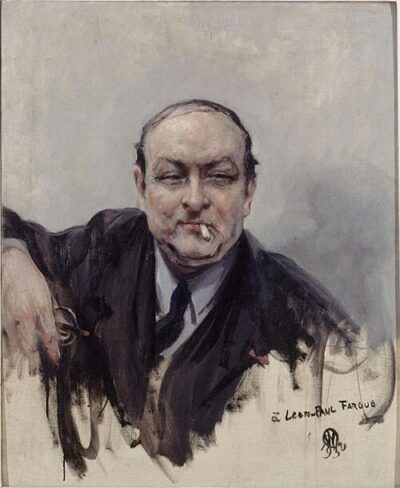
Léon-Paul Fargue
Léon-Paul Fargue was a French poet and essayist. Born March 4, 1876, in 1st arrondissement of Paris. Died November 24, 1947, in Paris. Educated at Lycée Henri-IV. Awards include Grand Prix littéraire de la Ville de Paris, Knight of the Legion of Honour and Georges-Dupau award.
Facts
16 facts · 2 confirmed by two sources · 8 cited · 6 from one source
Where this comes from
Papalocal keeps its own record. It started from these sources; what each one said is kept here as it was copied, so a change on their side never changes this page by itself. Tap one to read its version.
What Wikidata says · copied November 16, 2026 · revision 2559165194
- Described as
- French poet and essayist (1876–1947)
- Other names
- Leon-Paul Fargue
- Born
- March 4, 1876 · 8 references
- Died
- November 24, 1947 · 8 references
- Born in
- 1st arrondissement of Paris
- Died in
- Paris · 1 reference
- Buried in
- Montparnasse Cemetery
- Citizen of
- France · 1 reference
- Occupation
- poet · 2 references; writer · 1 reference; painter · 1 reference
- Worked for
- Le Figaro
- Education
- Lycée Henri-IV
- Member of
- Académie Mallarmé
- Awards
- Grand Prix littéraire de la Ville de Paris (1946) · 1 reference; Knight of the Legion of Honour (1925) · 1 reference; Georges-Dupau award (1942) · 1 reference
- Spouse
- Chériane
- Wikipedias with a page
- 28
Wikidata item Q599801 (wikidata.org/wiki/Q599801), public domain (CC0). Copied November 16, 2026.
What Wikipedia says · copied November 16, 2026 · revision 1371737303
Léon-Paul Fargue (French pronunciation: [leɔ̃ pɔl faʁɡ], 4 March 1876 – 24 November 1947) was a French poet and essayist.
He was born in Paris, France, on rue Coquilliére. As a poet he was noted for his poetry of atmosphere and detail. His work spanned numerous literary movements. Before he reached 19 years of age, Fargue had already published in L'Art littéraire in 1894 and his important poem Tancrède appeared in the magazine Pan in 1895.
As an opponent of the surrealists, he became a member of the Symbolist poetry circle connected with Le Mercure de France. Rilke, Joyce and others declared that Fargue was at the very forefront of modern poetry.
He was also a poet of Paris, and later in his career he published two books about the city, D'après Paris (1931) and Le piéton de Paris (1939). His earliest work is divided between Paris prowlings and intimate scenes of childhood and nature.
He was a great social lion in the literary scene of Paris in the 1920s and 30s. Walter Benjamin (who called Fargue "the greatest living poet in France") met him on a visit to the city in January 1930, and recounted an evening enlivened by charisma, wit, and incomparable storytelling. Fargue related to Benjamin the story of a dinner he held for Proust, his old friend, and James Joyce – the only time the two met.
"Fargue", wrote Leon-Pierre Quint in November 1929, "is one of those people who write as they speak; he constantly utters works that remain unwritten-perhaps from indolence, perhaps from contempt for writing. An endless sequence of unforced flashes of wit and puns-this was the only way he was capable of speaking. He has a childlike love of Paris, with its godforsaken little cafes, its bars, its streets, and its nightlife that never ends. He must be in robust health and have a highly resilient character. During the day he works as an industrialist, and at night he is always on the move. He is constantly seen with elegant women, Americans. He is close to fifty years of age, yet leads the life of a gigolo by night, hypnotizing everyone he meets with the charm of his speech."
Fargue published a book of recollections about his friend, the composer Ravel. He was a member of the Apaches and remained a lifelong friend of Ravel. One of his poems, Rêves, was set to music by Ravel in 1927.
He died in Paris in 1947 and is buried in the Cimetière du Montparnasse. Federico Mompou dedicated No. 12 of his Cançons i Danses to Fargue's memory.
- Born, in its opening lines
- March 4, 1876
- Died, in its opening lines
- November 24, 1947
From the Wikipedia article “Léon-Paul Fargue” (en.wikipedia.org/wiki/Léon-Paul_Fargue), by its contributors, under CC BY-SA 4.0 (creativecommons.org/licenses/by-sa/4.0/). Copied November 16, 2026; not changed.
Confirmed Two sources agree. Cited One source, and it names where it got it. One source One source, without a reference of its own. Sources disagree The sources disagree. We show the best-supported value and keep theirs below.
