
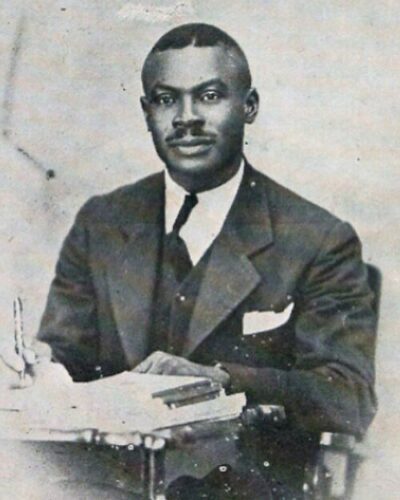
Leonard Howell
Leonard Howell was a Jamaican Rastafari preacher. Born June 16, 1898, in Clarendon Parish. Died February 12, 1981, in Kingston.
Facts
9 facts · 1 confirmed by two sources · 0 cited · 7 from one source · 1 where the sources disagree
What’s different
- Died: we show February 12, 1981 (Sources disagree). Wikipedia says January 23, 1981
Where this comes from
Papalocal keeps its own record. It started from these sources; what each one said is kept here as it was copied, so a change on their side never changes this page by itself. Tap one to read its version.
What Wikidata says · copied November 18, 2026 · revision 2567770370
- Described as
- Jamaican Rastafari preacher (1898–1981)
- Other names
- Leonard Percival Howell
- Born
- June 16, 1898 · 1 reference
- Died
- February 12, 1981 · 1 reference
- Born in
- Clarendon Parish
- Died in
- Kingston
- Citizen of
- Jamaica
- Occupation
- preacher
- Religion
- Rastafari
- Nickname
- Gong; Ganguru Maragh
- Wikipedias with a page
- 20
Wikidata item Q372368 (wikidata.org/wiki/Q372368), public domain (CC0). Copied November 18, 2026.
What Wikipedia says · copied November 18, 2026 · revision 1382151272
Leonard Percival Howell (16 June 1898 – 23 January 1981), also known as The Gong or G. G. Maragh (for Gangun Guru), was a Jamaican religious figure. According to his biographer Hélène Lee, Howell was born into an Anglican family. He was one of the first preachers of the Rastafari movement (along with Joseph Hibbert and Archibald Dunkley), and is known by many as The First Rasta.
Born in May Crawle River on 16 June 1898, Howell left Jamaica as a youth, travelling to many places, including Panama and New York, and returned in 1932. He began preaching in 1933 about what he considered the symbolic portent for the African diaspora—the crowning of Ras Tafari Makonnen as Emperor Haile Selassie I of Ethiopia. His preaching asserted that Haile Selassie was the "Messiah returned to earth", and he published a book called The Promised Key. Although this resulted in his being arrested, tried for sedition, and imprisoned for two years, the Rastafari movement grew.
Over the following years, Howell came into conflict with all the establishment authorities in Jamaica: the planters, the trade unions, established churches, police, and colonial authorities. Howell was seen as a threat largely due to the anti-colonial message of the Rastafarian movement, which he was perpetuating along with the sermons promoting the idea of a positive black racial identity. Local ruling elites were uneasy with Howell’s popular call for black people to take a stand. Colonial authorities hoped to quell Howell’s growing movement early so as to snuff out support early on.
As his following grew, the threat of Howell's core beliefs in the power of black people to overcome white oppression, and his movement, expanded to become an international concern given his strong messages of black liberation and Pan-Africanism that resonated with blacks across the globe. He formed a town or commune called Pinnacle in Saint Catherine Parish that became famous as a place for Rastafari. This movement prospered, and today the Rastafari faith exists worldwide. Unlike many Rastafari, Howell never wore dreadlocks.
Leonard Howell died in Kingston, Jamaica, on 23 January 1981 after suffering a vicious attack months earlier where he was slashed in the face and beaten badly at the age of 83 in Tredegar Park, St. Catherine not far from Pinnacle.
Although Howell suffered much abuse for the foundation of Rastafari, his legacy as a perceived true hero and leader in anti-colonialism took root throughout Jamaica and the Caribbean and eventually globally. Ironically, the same government who sought his continual persecution has in 2022 awarded L.P. Howell or 'Gong' with an Order of Distinction.
- Born, in its opening lines
- June 16, 1898
- Died, in its opening lines
- January 23, 1981
From the Wikipedia article “Leonard Howell” (en.wikipedia.org/wiki/Leonard_Howell), by its contributors, under CC BY-SA 4.0 (creativecommons.org/licenses/by-sa/4.0/). Copied November 18, 2026; not changed.
Confirmed Two sources agree. Cited One source, and it names where it got it. One source One source, without a reference of its own. Sources disagree The sources disagree. We show the best-supported value and keep theirs below.
