
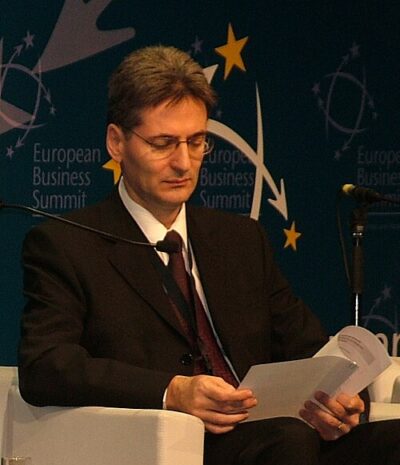
Leonard Orban is a Romanian politician. Born June 28, 1961, in Brașov. Positions held include European Commissioner (2007–2009). Educated at Transilvania University of Brașov and Bucharest University of Economic Studies. Awards include Grand Officer of the Order of Prince Henry, Knight of the Order of the Star of Romania and Order of the Cross of Terra Mariana, 3rd Class.
Facts
14 facts · 1 confirmed by two sources · 7 cited · 6 from one source
Where this comes from
Papalocal keeps its own record. It started from these sources; what each one said is kept here as it was copied, so a change on their side never changes this page by itself. Tap one to read its version.
What Wikidata says · copied November 18, 2026 · revision 2567615326
- Described as
- Romanian politician
- Born
- June 28, 1961 · 2 references
- Born in
- Brașov · 1 reference
- Citizen of
- Romania
- Occupation
- economist · 1 reference; politician · 1 reference; engineer
- Positions held
- European Commissioner (2007–2009)
- Political party
- National Liberal Party
- Education
- Transilvania University of Brașov; Bucharest University of Economic Studies
- Awards
- Grand Officer of the Order of Prince Henry · 1 reference; Knight of the Order of the Star of Romania (2021) · 1 reference; Order of the Cross of Terra Mariana, 3rd Class (2021) · 1 reference
- Siblings
- Ludovic Orban · 1 reference
- Wikipedias with a page
- 20
Wikidata item Q463274 (wikidata.org/wiki/Q463274), public domain (CC0). Copied November 18, 2026.
What Wikipedia says · copied November 18, 2026 · revision 1378319454
Leonard Orban (born 28 June 1961) is a Romanian independent technocrat who served as the Commissioner for Multilingualism in the European Commission, the executive body of the European Union (EU). He was responsible for the EU language policy and was the first Romanian Commissioner and the first member of the Commission whose portfolio is exclusively multilingualism. His term of office began on 1 January 2007 and ended on 9 February 2010. With a background in engineering and economics, Orban has taken up various posts working for the accession of Romania to the European Union, most prominently as Deputy and later as Chief Negotiator for his country at the time of final negotiations with the European Union.
Steering the multilingualism language policy of the EU, Orban focused on promoting foreign language learning through EU programmes such as the Lifelong Learning Programme 2007–2013. In addition, his remit also included the effective functioning of the EU's extensive interpretation, translation and publication services in the 23 official languages. To support the remit of his portfolio, Orban oversaw a staff of 3,400 in total (approximately 15 per cent of the Brussels executive's workforce) and approximately 1 per cent of the EU budget.
Though unaffiliated to any political party, Orban adheres to liberalism. He supports Romania's closer European integration and a strong European Union, and were in favour of the relaunch of the frozen Treaty establishing a Constitution for Europe without modifications to the original text.
Between 2011 and 2012 he was the Romanian Minister of European Affairs in the second Boc, Ungureanu and first Ponta cabinets.
- Born, in its opening lines
- June 28, 1961
From the Wikipedia article “Leonard Orban” (en.wikipedia.org/wiki/Leonard_Orban), by its contributors, under CC BY-SA 4.0 (creativecommons.org/licenses/by-sa/4.0/). Copied November 18, 2026; not changed.
Confirmed Two sources agree. Cited One source, and it names where it got it. One source One source, without a reference of its own. Sources disagree The sources disagree. We show the best-supported value and keep theirs below.
