
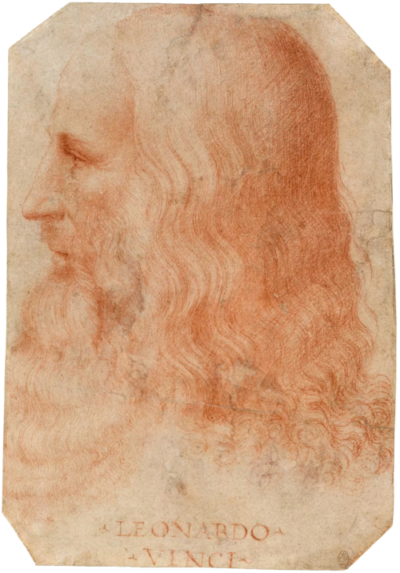
Leonardo da Vinci
Leonardo da Vinci was an Italian Renaissance polymath (1452−1519). Born April 15, 1452, in Anchiano. Died May 2, 1519, in Clos Lucé. Known for Adoration of the Magi, Virgin of the Rocks and Mona Lisa.
Facts
43 facts · 2 confirmed by two sources · 13 cited · 28 from one source
Where this comes from
Papalocal keeps its own record. It started from these sources; what each one said is kept here as it was copied, so a change on their side never changes this page by itself. Tap one to read its version.
What Wikidata says · copied November 16, 2026 · revision 2568965730
- Described as
- Italian Renaissance polymath (1452−1519)
- Other names
- Leonardo, Leonard, Leonardo Da Vinci, Leonardo di ser Piero da Vinci, da Vinci, Léonard
- Born
- April 15, 1452 · 5 references
- Died
- May 2, 1519 · 5 references
- Born in
- Anchiano · 3 references
- Died in
- Clos Lucé · 3 references
- Buried in
- Château d'Amboise
- Cause of death
- cerebral hemorrhage
- Name at birth
- Leonardo di ser Piero da Vinci · 1 reference
- Citizen of
- Republic of Florence
- Occupation
- painter · 5 references; engineer · 2 references; astronomer; anatomist; mathematician · 1 reference; sculptor · 4 references; polymath · 1 reference; architect · 5 references
- Worked for
- Ludovico Sforza (1482–1500) · 1 reference; Cesare Borgia
- Genre
- portrait; religious painting · 1 reference; religious art · 1 reference
- Known for
- Adoration of the Magi; Virgin of the Rocks; Mona Lisa · 1 reference; The Last Supper; Lady with an Ermine; Vitruvian Man; Annunciation; Saint Jerome in the Wilderness; The Virgin and Child with Saint Anne; Saint John the Baptist
- Field
- Renaissance architecture; scenography; engineering; physiology; painting · 9 references
- Father
- Piero da Vinci
- Mother
- Caterina di Meo Lippi
- Religion
- atheism · 1 reference
- Lived in
- Venice; Florence (2 times) (1469–); Rome · 1 reference; Milan (1482–1500) · 2 references
- Wikipedias with a page
- 309
Wikidata item Q762 (wikidata.org/wiki/Q762), public domain (CC0). Copied November 16, 2026.
What Wikipedia says · copied November 16, 2026 · revision 1385705082
Leonardo di ser Piero da Vinci (15 April 1452 – 2 May 1519), better known as Leonardo da Vinci, was an Italian polymath of the High Renaissance who was active as a painter, draughtsman, engineer, scientist, anatomist, sculptor, and architect. While his fame initially rested on his achievements as a painter, he has also become known for his notebooks, in which he made drawings and notes on a variety of subjects, including anatomy, astronomy, botany, cartography, painting, and palaeontology. Leonardo is widely regarded as a genius who epitomised the Renaissance humanist ideal, and his collective works contributed to the development of European art to an extent rivalled only by that of his younger contemporary Michelangelo.
Born out of wedlock to a young peasant woman and a successful notary in (or near) Vinci in Tuscany, he was educated in Florence by the Italian painter and sculptor Andrea del Verrocchio. He began his career in the city, but then spent much time in the service of Ludovico Sforza in Milan. Later, he worked in Florence and Milan again, as well as briefly in Rome, all while attracting a large following of imitators and students. Upon the invitation of Francis I, he spent his last three years in France, where he died in 1519. Since his death, there has not been a time when his achievements, diverse interests, personal life, and empirical thinking have failed to incite interest and admiration, making him a frequent namesake and subject in culture.
Leonardo is identified as one of the greatest painters in the history of Western art and is often credited as the founder of the High Renaissance. Despite having many lost works and fewer than 25 attributed major works – including numerous unfinished works – he created some of the most influential paintings in the Western canon. The Mona Lisa is regarded as the world's most famous painting. The Last Supper is the most reproduced religious painting of all time and his Vitruvian Man drawing is also regarded as a cultural icon. In 2017, Salvator Mundi, attributed in whole or part to Leonardo, was sold at auction for US$450.3 million, setting a new record for the most expensive painting ever sold at public auction.
Revered for his technological ingenuity, he conceptualised flying machines, a type of armoured fighting vehicle, concentrated solar power, a ratio machine that could be used in an adding machine, and the double hull. Relatively few of his designs were constructed or were even feasible during his lifetime, as the modern scientific approaches to metallurgy and engineering were only in their infancy during the Renaissance. Some of his smaller inventions, however, entered the world of manufacturing unheralded, such as an automated bobbin winder and a machine for testing the tensile strength of wire. He made substantial discoveries in anatomy, civil engineering, hydrodynamics, geology, optics, and tribology, but he did not publish his findings and they had little to no direct influence on subsequent science.
- Born, in its opening lines
- April 15, 1452
- Died, in its opening lines
- May 2, 1519
From the Wikipedia article “Leonardo da Vinci” (en.wikipedia.org/wiki/Leonardo_da_Vinci), by its contributors, under CC BY-SA 4.0 (creativecommons.org/licenses/by-sa/4.0/). Copied November 16, 2026; not changed.
Confirmed Two sources agree. Cited One source, and it names where it got it. One source One source, without a reference of its own. Sources disagree The sources disagree. We show the best-supported value and keep theirs below.
