
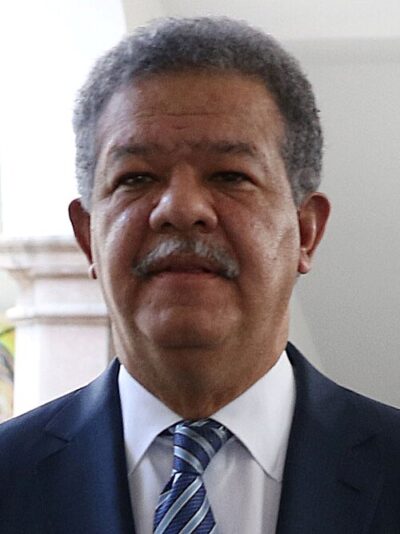
Leonel Fernández
Leonel Fernández is a former president of the Dominican Republic. Born December 26, 1953, in Santo Domingo. Positions held include President of the Dominican Republic (2 times) (1996–2012), President of the Dominican Liberation Party (2002–2019) and President of the People's Force (2019–). Educated at Autonomous University of Santo Domingo. Awards include Order of Christopher Columbus, Order of the Quetzal and Knight Grand Cross with Collar of the Order of Merit of the Italian Republic.
Facts
29 facts · 1 confirmed by two sources · 7 cited · 21 from one source
Where this comes from
Papalocal keeps its own record. It started from these sources; what each one said is kept here as it was copied, so a change on their side never changes this page by itself. Tap one to read its version.
What Wikidata says · copied November 16, 2026 · revision 2563681361
- Described as
- former president of the Dominican Republic
- Other names
- Leonel Fernandez, Leonel Antonio Fernández Reyna
- Born
- December 26, 1953 · 4 references
- Born in
- Santo Domingo · 1 reference
- Citizen of
- Dominican Republic
- Occupation
- politician · 1 reference; lawyer; writer · 2 references; jurist · 1 reference
- Positions held
- President of the Dominican Republic (2 times) (1996–2012); President of the Dominican Liberation Party (2002–2019) · 2 references; President of the People's Force (2019–) · 2 references
- Political party
- Dominican Liberation Party; Fuerza del Pueblo · 1 reference
- Education
- Autonomous University of Santo Domingo
- Awards
- Order of Christopher Columbus; Order of the Quetzal (2011) · 1 reference; Knight Grand Cross with Collar of the Order of Merit of the Italian Republic (1999) · 1 reference; Order of José Cecilio del Valle (2013); honorary doctor of the University of Paris 1 Pantheon-Sorbonne (1999) · 2 references; Order of Merit of Duarte, Sanchez and Mella · 1 reference; Order of Brilliant Jade · 1 reference; Order of Merit of the Italian Republic · 1 reference; Order of the Liberator General San Martín · 1 reference; Order of José Martí · 1 reference; Order of Independence · 1 reference; honorary doctor of Paris 8 University (2013) · 1 reference
- Spouse
- Margarita Cedeño
- Children
- Omar Fernández
- Religion
- Catholicism
- Website
- http://www.leonelfernandez.com · 1 reference
- Wikipedias with a page
- 47
Wikidata item Q151944 (wikidata.org/wiki/Q151944), public domain (CC0). Copied November 16, 2026.
What Wikipedia says · copied November 16, 2026 · revision 1385892446
Leonel Antonio Fernández Reyna (born 26 December 1953) ( lay-oh-NEHL fer-NAHN-dehss), is a Dominican lawyer, academic, and was the 50th and 52nd President of the Dominican Republic from 1996 to 2000 and from 2004 to 2012. From 2016 until 2020, he was the President of the EU–LAC Foundation.
Fernández became the first elected president of the Dominican Republic under his political party, the Dominican Liberation Party (Partido de la Liberación Dominicana, or PLD), although party founder Juan Bosch was also sworn in as president in 1963 after the first democratic elections held in roughly four decades in the country. Fernández's administrations have focused much on technological and infrastructural development and macroeconomic and monetary stability. He has served as the party president of the Dominican Liberation Party from 2001 until his resignation on 20 October 2019. He later founded the People's Force and nominated himself as its party's presidential nominee.
He is a native of Villa Juana, Distrito Nacional and lived for much of his childhood and early adulthood in New York City.
Fernández is a former president of the World Federation of United Nations Associations (2018-2022) and a member of the Inter-American Dialogue.
- Born, in its opening lines
- December 26, 1953
From the Wikipedia article “Leonel Fernández” (en.wikipedia.org/wiki/Leonel_Fernández), by its contributors, under CC BY-SA 4.0 (creativecommons.org/licenses/by-sa/4.0/). Copied November 16, 2026; not changed.
Confirmed Two sources agree. Cited One source, and it names where it got it. One source One source, without a reference of its own. Sources disagree The sources disagree. We show the best-supported value and keep theirs below.
