
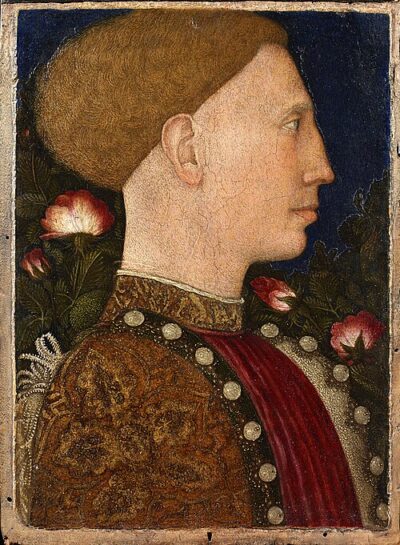
Leonello d'Este, Marquis of Ferrara
Leonello d'Este, Marquis of Ferrara was an Italian nobleman and Marquis of Ferrara, Modena and Reggio. Born September 21, 1407, in Ferrara. Died October 1, 1450, in Voghiera. Positions held include Marquess (1441–1450).
Facts
20 facts · 2 confirmed by two sources · 2 cited · 16 from one source
Where this comes from
Papalocal keeps its own record. It started from these sources; what each one said is kept here as it was copied, so a change on their side never changes this page by itself. Tap one to read its version.
What Wikidata says · copied November 17, 2026 · revision 2565553898
- Described as
- Italian nobleman and Marquis of Ferrara, Modena and Reggio (1407–1450)
- Other names
- Leonello d'Este, Podestà di Ferrara
- Born
- September 21, 1407
- Died
- October 1, 1450 · 1 reference
- Born in
- Ferrara
- Died in
- Voghiera
- Buried in
- Ferrara · 1 reference
- Occupation
- ruler; patron of the arts; philosopher
- Positions held
- Marquess (1441–1450)
- Spouse
- Margherita Gonzaga · 1 reference; Maria of Aragon
- Children
- Niccolò d'Este
- Father
- Niccolò III d'Este · 1 reference
- Mother
- Stella de' Tolomei · 1 reference
- Siblings
- Ginevra d'Este; Ercole I d'Este; Ugo d'Este; Sigismondo d'Este; Meliaduse d'Este; Borso d'Este
- Wikipedias with a page
- 25
Wikidata item Q1379797 (wikidata.org/wiki/Q1379797), public domain (CC0). Copied November 17, 2026.
What Wikipedia says · copied November 17, 2026 · revision 1365011272
Leonello d'Este (also spelled Lionello; 21 September 1407 – 1 October 1450) was Marquess of Ferrara, Modena, and Reggio Emilia from 1441 to 1450. Despite the presence of legitimate children, Leonello was favoured by his father as his successor. In addition, his virtuous qualities, high level of education, and popularity among the common people as well as his formal papal recognition ultimately made him the most suitable heir.
Leonello had little influence over the Italian political landscape and aristocracy in Ferrara. Contrary to other prior d’Este family leaders, such as Azzo VII, Niccolò III, and Isabella d’Este, who had a drive for power and control, Leonello is recognized principally for his sponsorship of the arts, literature, and culture. In 1441–1450, his learned courts and developing knowledge assisted him in transforming the city of Ferrara. Under the guidance of Guarino Veronese, his humanist teacher, and with the approval of the commune, Leonello began the reformation, particularly, the University of Ferrara.
Leonello not only elevated the humanistic cultural movements during his rule, but it also influenced the political and artistic advancements of his successors. Leonello d’Este served as the precursor of the achievements in the history of the House of Este.
- Born, in its opening lines
- September 21, 1407
- Died, in its opening lines
- October 1, 1450
From the Wikipedia article “Leonello d'Este” (en.wikipedia.org/wiki/Leonello_d'Este), by its contributors, under CC BY-SA 4.0 (creativecommons.org/licenses/by-sa/4.0/). Copied November 17, 2026; not changed.
Confirmed Two sources agree. Cited One source, and it names where it got it. One source One source, without a reference of its own. Sources disagree The sources disagree. We show the best-supported value and keep theirs below.
