
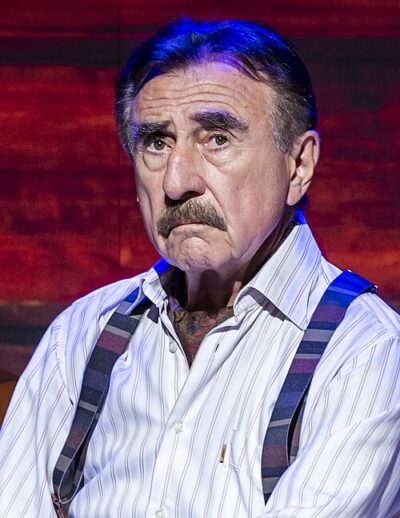
Leonid Kanevsky
Leonid Kanevsky is a Soviet, Russian and Israeli theater and film actor, TV presenter. Born May 2, 1939, in Kyiv. Educated at Boris Shchukin Theatre Institute. Awards include Order of Friendship and Honored Artist of the RSFSR.
Facts
17 facts · 0 confirmed by two sources · 0 cited · 17 from one source
Where this comes from
Papalocal keeps its own record. It started from these sources; what each one said is kept here as it was copied, so a change on their side never changes this page by itself. Tap one to read its version.
What Wikidata says · copied November 17, 2026 · revision 2540262460
- Described as
- Soviet, Russian and Israeli theater and film actor, TV presenter
- Other names
- Leonid Kanevskiy, Leonid Kanevskii, Leonid Kanevskyi
- Born
- May 2, 1939
- Born in
- Kyiv
- Citizen of
- Russia; Israel; Soviet Union
- Occupation
- actor; film actor; stage actor; presenter; television presenter · 1 reference; film director · 1 reference; television actor
- Education
- Boris Shchukin Theatre Institute
- Awards
- Order of Friendship (2010); Honored Artist of the RSFSR (1984)
- Siblings
- Aleksandr Kanevsky
- Religion
- Judaism
- Wikipedias with a page
- 28
Wikidata item Q1987569 (wikidata.org/wiki/Q1987569), public domain (CC0). Copied November 17, 2026.
What Wikipedia says · copied November 17, 2026 · revision 1357040049
Leonid Semyonoviсh Kanevski (Ukrainian: Леонід Семенович Каневський, Russian: Леони́д Семёнович Кане́вский, Hebrew: לאוניד קנבסקי; 2 May 1939, Kyiv, Ukrainian SSR) is a Soviet, Russian and Israeli actor. He became popular with the Soviet audience after starring in The Investigation Is Conducted by ZnaToKi detective series where he appeared as major Tomin.
From the Wikipedia article “Leonid Kanevsky” (en.wikipedia.org/wiki/Leonid_Kanevsky), by its contributors, under CC BY-SA 4.0 (creativecommons.org/licenses/by-sa/4.0/). Copied November 17, 2026; not changed.
Confirmed Two sources agree. Cited One source, and it names where it got it. One source One source, without a reference of its own. Sources disagree The sources disagree. We show the best-supported value and keep theirs below.
