
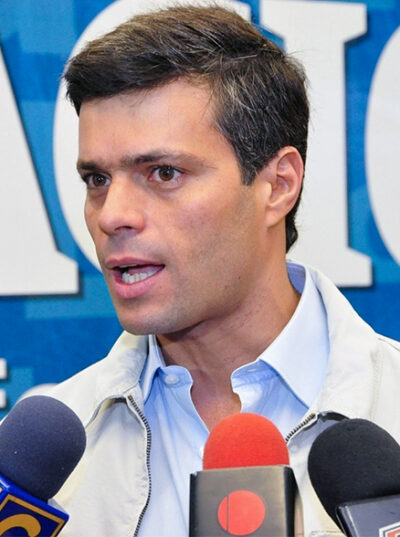
Leopoldo López
Leopoldo López is a Venezuelan politician. Born April 29, 1971, in Caracas. Educated at John F. Kennedy School of Government and Kenyon College. Awards include Freedom Award, Courage Award and Prize of the Platform of European Memory and Conscience.
Facts
22 facts · 1 confirmed by two sources · 3 cited · 18 from one source
Where this comes from
Papalocal keeps its own record. It started from these sources; what each one said is kept here as it was copied, so a change on their side never changes this page by itself. Tap one to read its version.
What Wikidata says · copied November 18, 2026 · revision 2566768800
- Described as
- Venezuelan politician
- Other names
- Leopoldo Lopez
- Born
- April 29, 1971
- Born in
- Caracas · 1 reference
- Citizen of
- Venezuela
- Occupation
- economist; politician · 1 reference; sociologist · 1 reference; mayor · 1 reference
- Political party
- Popular Will (2009–); A New Era (2007–2009); Primero Justicia (2000–2007); Interim government of Juan Guaidó (2019–2023)
- Education
- John F. Kennedy School of Government; Kenyon College; Hun School of Princeton
- Awards
- Freedom Award (2017); Courage Award; Prize of the Platform of European Memory and Conscience
- Spouse
- Lilian Tintori (2007–)
- Father
- Leopoldo López Gil
- Religion
- Catholicism
- Lived in
- Madrid
- Website
- http://www.leopoldolopez.com
- Wikipedias with a page
- 24
Wikidata item Q1672657 (wikidata.org/wiki/Q1672657), public domain (CC0). Copied November 18, 2026.
What Wikipedia says · copied November 18, 2026 · revision 1380668018
Leopoldo Eduardo López Mendoza (born 29 April 1971) is a Venezuelan opposition leader. López was elected mayor of the Chacao Municipality of Caracas in the regional elections held in July 2000. He is the National Coordinator of the political party, Voluntad Popular, which he founded in 2009. He is a Venezuelan politician, economist, and sociologist.
Administrative sanctions were imposed on López by Venezuela's Comptroller's Office in 2004, disqualifying him from holding public office for six years (beginning in 2008, at the completion of his term as mayor, until 2014), following allegations of nepotism and misappropriation of funds. Opposition groups in Venezuela criticized these charges as fabricated. López supporters say he was never charged with a crime, tried, or allowed to rebut the allegations; he sued Venezuela and his case was reviewed by the Inter-American Court of Human Rights, which issued a unanimous ruling in his favor. The ruling was ignored by Venezuelan officials.
During the crisis in Venezuela, he called for protests in February 2014. He was arrested on 18 February 2014 and charged with arson and conspiracy; murder and terrorism charges were dropped. Human rights groups expressed concern that the charges were politically motivated. His imprisonment in Ramo Verde was controversial; the UN High Commissioner for Human Rights called for the release of those arrested in connection with the protests. Opinion polls in late 2014 showed that López had become one of the most popular politicians in Venezuela following his arrest. In September 2015, he was found guilty of public incitement to violence through supposed subliminal messages, being involved with criminal association, and was sentenced to 13 years and 9 months in prison.
The European Union, Amnesty International, Human Rights Watch and several human rights organizations have condemned the arrest and defined it as politically motivated. Several figures involved with his trial later declared that they were pressured by the Venezuelan government to detain López. Franklin Nieves, the prosecutor that accused him, called the judicial process a "farce" and said that Nicolás Maduro pressured him and Public Ministry superiors to defend "false evidence" against López. Ralenis Tovar, the judge that signed the arrest warrant against Leopoldo, declared that she signed the warrant because she felt scared after being threatened with becoming a "second Lourdes Afiuni judge". Chief Prosecutor Luisa Ortega Díaz said that she was pressured by Diosdado Cabello to accuse López of the deaths of Bassil Da Costa and Juan Montoya.
He was later transferred to house arrest on 8 July 2017 after being imprisoned for over three years. On 1 August 2017 he was taken from his home by SEBIN agents and was briefly imprisoned once again in Ramo Verde. Since then, López returned home and remained under house arrest from 5 August 2017 until it was reported that López had been released on 30 April 2019, in the wake of the 2019 Venezuelan uprising. As the former attempt to overthrow Maduro's government fell apart, López took refuge as a guest in the Spanish Embassy in Caracas. He fled Venezuela in October 2020.
- Born, in its opening lines
- April 29, 1971
From the Wikipedia article “Leopoldo López” (en.wikipedia.org/wiki/Leopoldo_López), by its contributors, under CC BY-SA 4.0 (creativecommons.org/licenses/by-sa/4.0/). Copied November 18, 2026; not changed.
Confirmed Two sources agree. Cited One source, and it names where it got it. One source One source, without a reference of its own. Sources disagree The sources disagree. We show the best-supported value and keep theirs below.
