
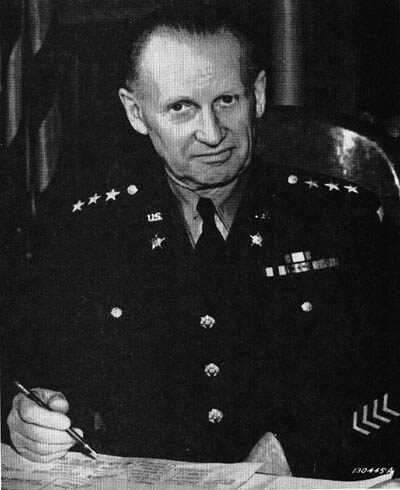
Lesley J. McNair
Lesley J. McNair was a recipient of the Purple Heart medal. Born May 25, 1883, in Verndale. Died July 25, 1944, in Saint-Lô. Educated at United States Military Academy and United States Army War College. Awards include Purple Heart and Officer of the Legion of Honour.
Facts
16 facts · 2 confirmed by two sources · 3 cited · 11 from one source
Where this comes from
Papalocal keeps its own record. It started from these sources; what each one said is kept here as it was copied, so a change on their side never changes this page by itself. Tap one to read its version.
What Wikidata says · copied November 18, 2026 · revision 2567746324
- Described as
- recipient of the Purple Heart medal (1883-1944)
- Other names
- Lesley J McNair, Lesley McNair, Lesley James McNair
- Born
- May 25, 1883 · 2 references
- Died
- July 25, 1944 · 2 references
- Born in
- Verndale
- Died in
- Saint-Lô · 1 reference
- Buried in
- Normandy American Cemetery and Memorial · 1 reference
- Citizen of
- United States
- Occupation
- military officer; military commander · 1 reference; soldier · 1 reference
- Education
- United States Military Academy; United States Army War College; South High School · 1 reference
- Awards
- Purple Heart; Officer of the Legion of Honour
- Military branch
- United States Army (1904–1944)
- Military rank
- general
- Wikipedias with a page
- 16
Wikidata item Q713462 (wikidata.org/wiki/Q713462), public domain (CC0). Copied November 18, 2026.
What Wikipedia says · copied November 18, 2026 · revision 1383755385
Lesley James McNair (25 May 1883 – 25 July 1944) was an American Army officer who served during World War I and World War II. He attained the rank of lieutenant general during his life; he was killed in action during World War II, and received a posthumous promotion to general.
A Minnesota native and 1904 graduate of the United States Military Academy, McNair was a Field Artillery officer with a background in the Ordnance Department. A veteran of the Battle of Veracruz and Pancho Villa Expedition, during World War I he served as assistant chief of staff for training with the 1st Division, and then chief of artillery training on the staff at the American Expeditionary Forces headquarters. His outstanding performance resulted in his promotion to temporary brigadier general; at age 35, he was the Army's second-youngest general officer.
McNair's experience of more than 30 years with equipment and weapons design and testing, his administrative skills, and his success in the areas of military education and training led to his World War II assignment as commander of Army Ground Forces. In this position, McNair became the "unsung architect of the U.S. Army", and played a leading role in the organizational design, equipping, and training of Army units in the United States before they departed for overseas combat. While historians continue to debate some of McNair's decisions and actions, including the individual replacement system for killed and wounded soldiers, and a controversy over the use of tanks or tank destroyers as anti-tank weapons, his concentration on advanced officer education, innovative weapons systems, improved doctrine, realistic combat training, and development of combined arms tactics enabled the Army to modernize and perform successfully on the World War II battlefield, where the mobility of mechanized forces replaced the static defenses of World War I as the primary tactical consideration.
He was killed by friendly fire while in France to act as commander of the fictitious First United States Army Group, part of the Operation Quicksilver deception that masked the actual landing sites for the Invasion of Normandy. During Operation Cobra, an Eighth Air Force bomb landed in his foxhole near Saint-Lô when the Army attempted to use heavy bombers for close air support of infantry operations as part of the Battle of Normandy.
- Born, in its opening lines
- May 25, 1883
- Died, in its opening lines
- July 25, 1944
From the Wikipedia article “Lesley J. McNair” (en.wikipedia.org/wiki/Lesley_J._McNair), by its contributors, under CC BY-SA 4.0 (creativecommons.org/licenses/by-sa/4.0/). Copied November 18, 2026; not changed.
Confirmed Two sources agree. Cited One source, and it names where it got it. One source One source, without a reference of its own. Sources disagree The sources disagree. We show the best-supported value and keep theirs below.
